
Practical guides · process
Planning Commercial Water Treatment Around Your Equipment
Before choosing commercial water treatment, gather the water results, equipment manuals and operating details that show what each station actually needs.
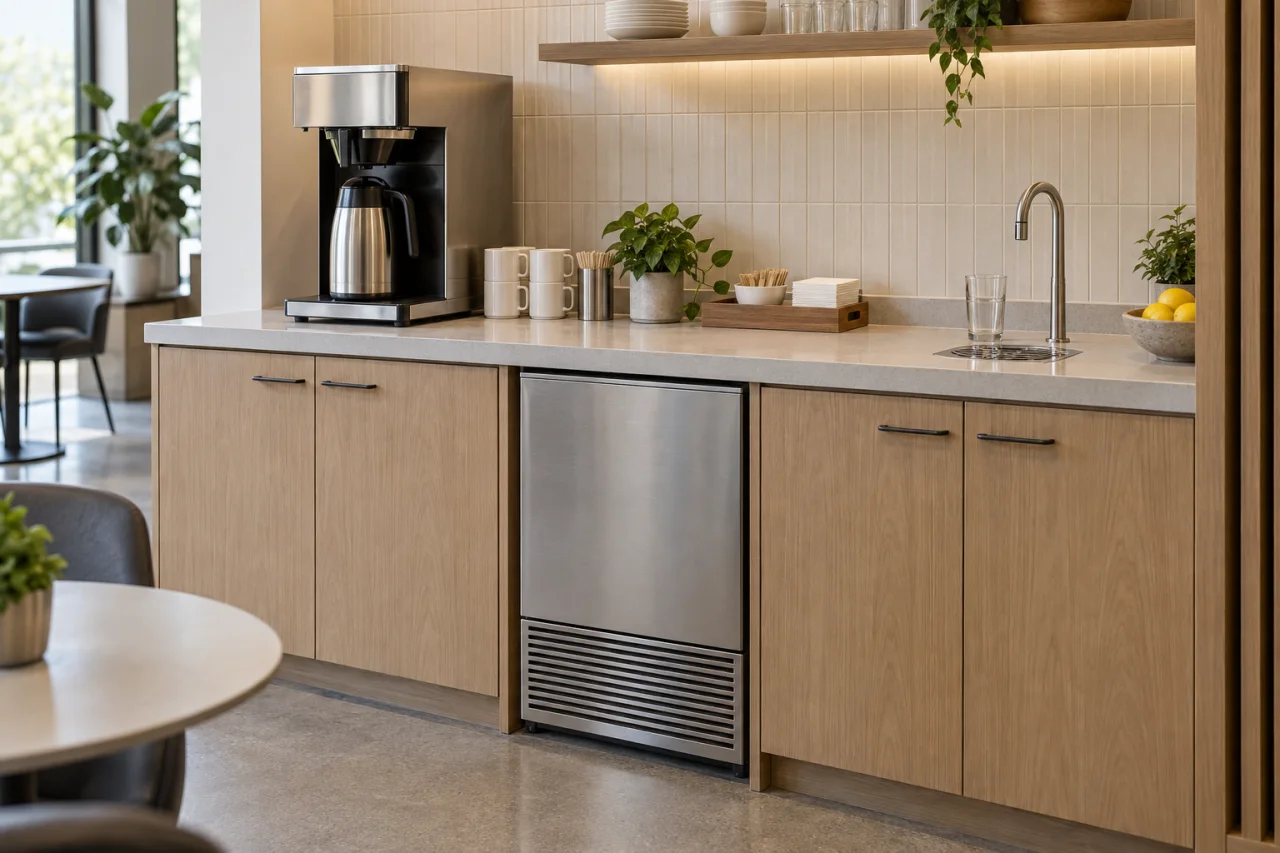
What you’ll learn
- Gather source-water information and dated results that identify where each sample was collected.
- Use exact equipment manuals; coffee brewers, ice machines and drinking taps may need different treatment.
- Describe simultaneous demand as well as daily use, and ask about flow, pressure and capacity separately.
- Plan service access, shutdowns and recurring maintenance before agreeing to equipment.
Before discussing water treatment for an office, café or restaurant, gather more than a water bill and a description of the taste. A useful planning brief connects the incoming supply to the equipment using it, the busiest periods of demand and the time available for maintenance. Start with the questions below to make a Commercial Water Treatment discussion more focused. The aim is not to choose the biggest system, but to define the water quality and delivery conditions each outlet needs.
Start with the supply and the sampling location
Identify the building’s actual supply: public water, a well or another arrangement. For public water, gather the supplier’s latest water quality report. It provides source and monitoring context, but it is not a measurement at your brewer’s inlet after the building’s plumbing and existing filters.
Bring available laboratory reports with the collection date, sampling location, units and any treatment operating when the sample was taken. A result from a filtered drinking tap should not be treated as the untreated supply result.
If information is missing, discuss Water Testing before selecting equipment. Ask which measurements answer the specific question: mineral buildup, taste, discoloration or a suspected contaminant. For help preparing samples and interpreting results, start with understanding the testing steps.
Collect the manuals, not just the appliance names
Build an equipment inventory before choosing a treatment technology. Include plumbed coffee brewers, ice machines, drinking taps and any other equipment proposed for the same treated-water branch.
Use model-specific documentation rather than a general rule for all coffee or ice equipment. For example, the BUNN Premia guide specifies supply-pressure conditions and gives chlorine and hardness guidance. Those instructions should not automatically be transferred to another brewer.
Also identify leased equipment and ask who must approve supply changes. If a manual is unclear, obtain clarification from the equipment manufacturer or responsible service provider before making a treatment decision.
- List each water-using appliance, its exact model and its location.
- Collect installation manuals, water-quality requirements and maintenance instructions.
- Identify existing filter housings, cartridge models and replacement records.
- Record observed symptoms and when they occur, without assuming their cause.
Separate coffee, ice and general-use requirements
Different outlets can have different objectives. A beverage station may need an equipment-specific mineral balance, while a general-use tap may be considered for a particular taste concern or contaminant-reduction claim. The strongest treatment is not automatically the best match.
Use the comparison below to organize questions, not to select a universal cartridge. Then compare water treatment options against both the water results and the connected equipment’s requirements.
Different uses require different planning questions; these are not universal treatment specifications.
| Water use | Information to compare | Applicability and limitation |
|---|---|---|
| Coffee brewer | Compare chlorine, hardness and supply conditions with the exact brewer manual. | Another brewer’s recommended treatment may not meet this model’s requirements. |
| Ice machine | Check the model’s water supply, operating limits and maintenance requirements. | Water-cooled equipment may have a separate condenser-water circuit; do not combine its requirements with ice-making water. |
| General-use drinking tap | Define whether the objective is taste improvement or reduction of a specific contaminant. | Certification to a standard does not mean reduction of every contaminant. |
Describe the busiest overlap in demand
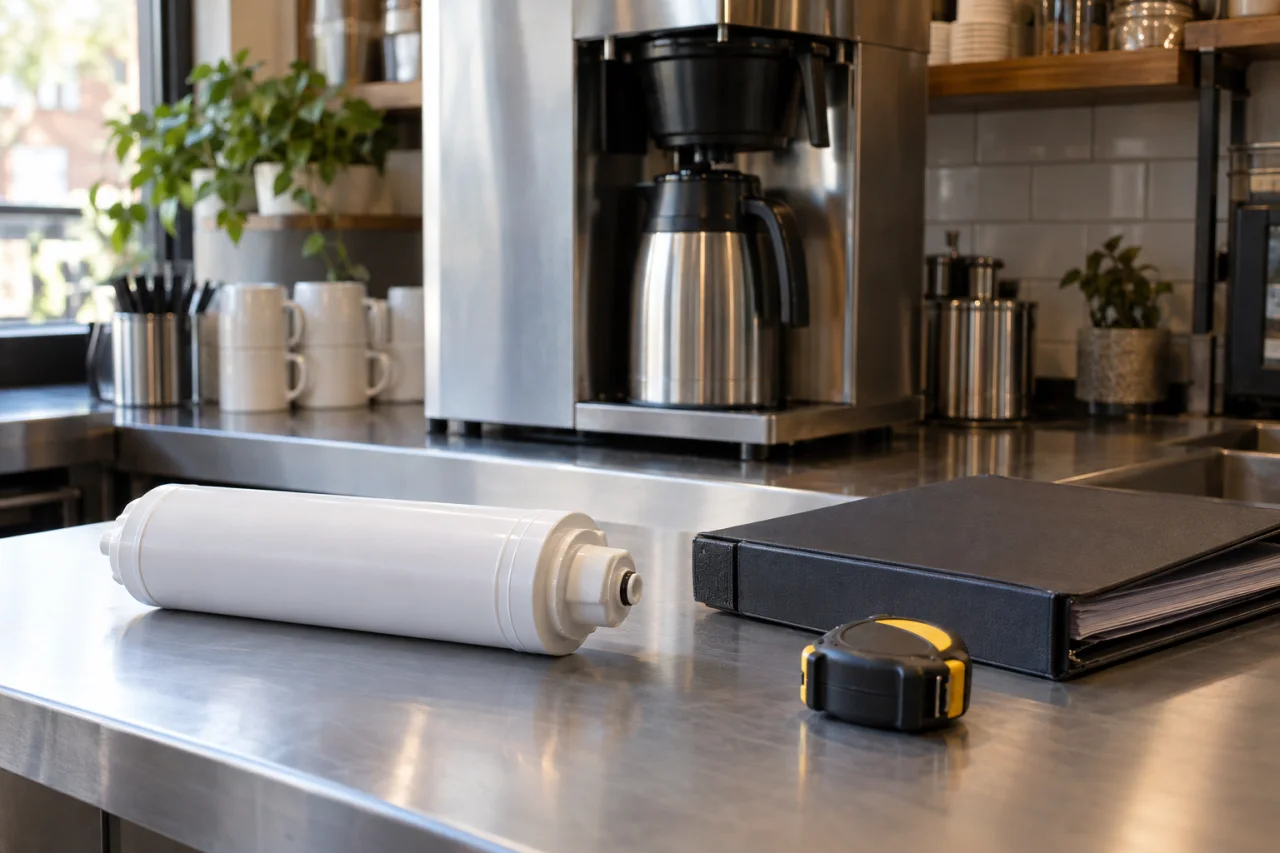
Describe the busiest operating period, not only the average day. In an office, brewers and drinking taps may be used together during a break. In food service, ice-machine filling may overlap with beverage preparation and other demand.
Ask the proposed treatment provider to distinguish instantaneous flow from total treatment capacity. A cartridge’s gallon rating does not, by itself, establish that it can deliver enough water during simultaneous use. Request the proposed system’s rated flow and pressure-loss information under its stated conditions.
Record slow filling, interrupted cycles or changes during busy periods. Hoshizaki’s KM troubleshooting guidance identifies restricted filters, low pressure and inadequate inlet sizing among possible causes of insufficient filling. Treat those symptoms as reasons for assessment, not proof that treatment alone needs replacement.
Choose treatment locations around compatible needs
Compare a shared treatment location with dedicated equipment branches. A shared location is worth considering when the connected uses have compatible requirements. Separate branches deserve consideration when one appliance needs a different water specification or must be isolated independently for maintenance.
Ask for a simple description of which outlets would receive which treatment. Include any storage, drain connection, electrical supply or additional components required by the proposed design. Do not assume these are included because the main treatment unit appears on a quote.
For contaminant reduction, verify the exact certified claim. NSF/ANSI 42 addresses aesthetic claims such as chlorine taste and odor; NSF/ANSI 53 addresses specific health-effect contaminant claims. Neither number means a system treats every possible water problem.
Leave room for maintenance, not just installation
Evaluate the space as a maintenance location, not merely a place where equipment fits. A filter mounted behind stocked shelves may become difficult to service. An ice machine also needs its own specified access and ventilation clearances; treatment components should not obstruct them.
Hoshizaki’s F-1002 specification sheet illustrates why the exact model matters: it identifies service clearances and separate plumbing requirements for water-cooled versions. Those details are not dimensions to copy to every installation.
Ask the installer to explain the proposed layout and any site changes. Avoid moving or opening commercial appliances yourself to obtain hidden measurements.
- Photograph the proposed location and its surrounding storage or equipment.
- Measure usable space, including room to remove cartridges and open service panels.
- Identify accessible shutoffs and ask how affected equipment would be isolated.
- Note any landlord restrictions or uncertainty about drains and electrical connections.
Set an acceptable shutdown window and care plan
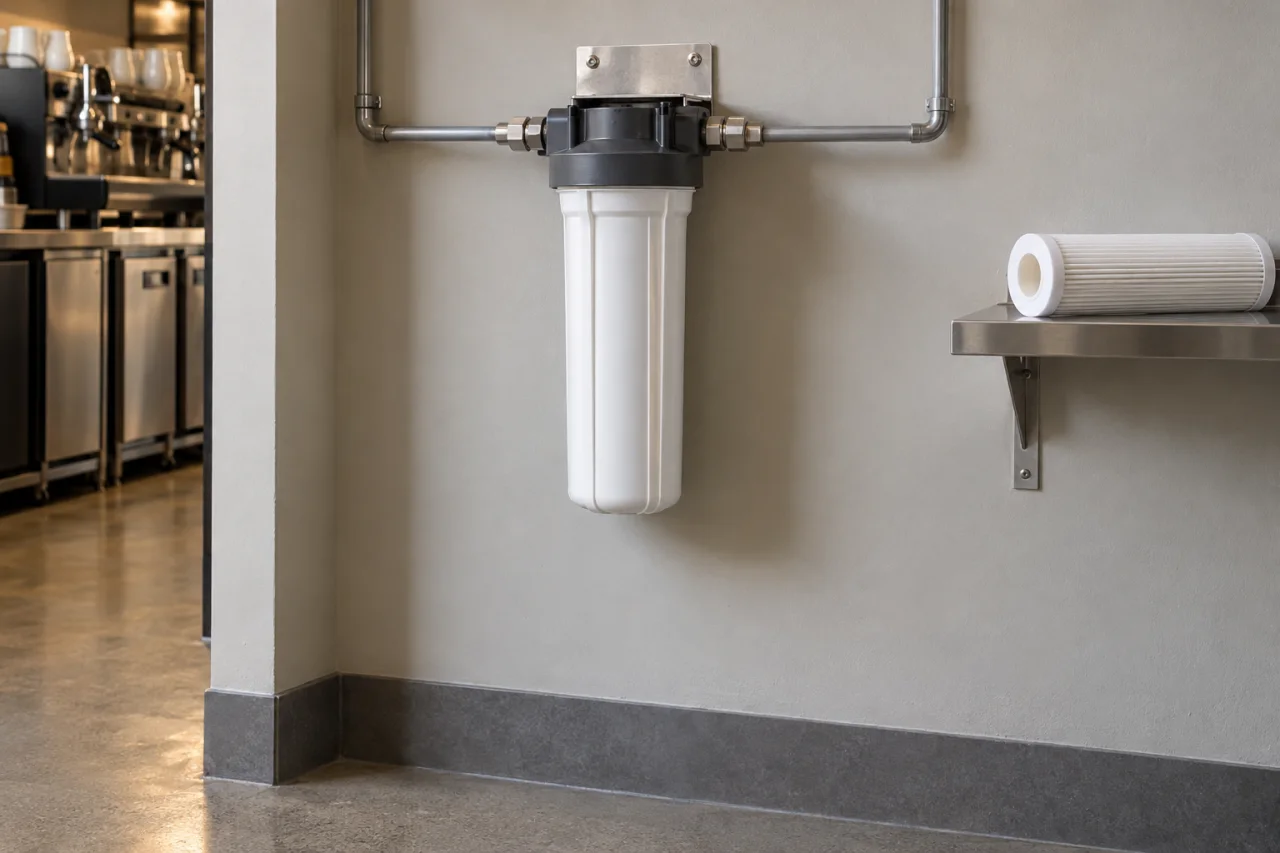
State how long each affected station can be unavailable and which business activities would stop with it. Ask what the proposed installation, cartridge changes and any required flushing would interrupt. Request a realistic shutdown scope rather than assuming work can happen between customers.
Keep treatment maintenance separate from appliance maintenance. The Hoshizaki KM-230/300 service manual includes external-filter pressure checks as well as ice-machine and bin cleaning and sanitizing. Water treatment does not replace those tasks.
Request replacement criteria, cartridge identifiers and instructions for extended closures or supply interruptions. Assign someone to retain maintenance records. When comparing ongoing commitments, consider capacity, consumables and downtime together rather than judging the initial equipment cost alone.
Bring a brief that makes proposals easier to evaluate
Turn the information into a short planning brief: supply source, dated results, equipment inventory, peak-use description, site photographs and acceptable downtime. Keep unknowns visible so they can be resolved before equipment is ordered.
For an office or food-service business in West End or elsewhere in Moore County, this is a useful starting point for discussing Commercial Water Treatment with The Water Knight. Water treatment visits are by arrangement. The goal of the first discussion should be a clearly defined need and proposed scope—not an assumption that one system will suit every outlet.
- What measured condition is each proposed treatment stage intended to address?
- How does the proposed output compare with each connected appliance’s requirements?
- What flow, pressure and capacity assumptions support the selection?
- What installation work, startup steps and recurring supplies are included?
- What maintenance remains the business’s responsibility?
Questions & answers
What should I gather before discussing commercial water treatment?
Bring the water-source information, available test reports, equipment model numbers and manuals, existing filter details, busy-period demand, photographs of the proposed location and your acceptable shutdown window. Note whether each result represents untreated water or water after existing treatment.
Can one system serve the brewer, ice machine and drinking taps?
Possibly, but only if its output and delivery capacity suit every connected use. Compare each appliance’s requirements first. Separate equipment branches may be more appropriate when mineral targets, flow needs or maintenance schedules differ.
Does a filter certification mean it removes every contaminant?
No. Certification applies to particular standards and claims. Check the exact system and replacement cartridge for the reduction claim you need, along with its operating conditions. A taste-and-odor claim is not a universal health-protection claim.
Will filtration eliminate ice-machine cleaning?
No. Ice-machine cleaning and sanitizing remain separate maintenance tasks. The applicable equipment manual should guide those tasks, while the treatment manufacturer’s instructions guide filter care and replacement.
Should I replace the filter if the ice machine makes small cubes?
A restricted filter is one possible explanation, not a complete diagnosis. Hoshizaki’s KM guidance also identifies low supply pressure, inlet restrictions and other equipment problems. Record the symptoms and have the cause assessed rather than assuming a larger filter will solve it.
Sources & further reading
- EPA: Home Water Testing
Explains public-water reports, reasons for water testing and the value of water-quality records. Used for supply and testing context, not as commercial compliance guidance. ([epa.gov](https://www.epa.gov/sites/default/files/2015-11/documents/2005_09_14_faq_fs_homewatertesting.pdf))
- BUNN Premia with Auto Clean: Installation and Operating Guide
The Premia guide’s site-requirements section provides model-specific cold-water pressure, supply-line, chlorine and hardness guidance. Supports consulting the applicable brewer manual rather than transferring requirements between models. ([resource.bunn.com](https://resource.bunn.com/assets/web/SupportHub/premia/AC/59224.0000%20C%20Premia%20IO%20Guide%20with%20Auto%20Clean.pdf))
- Hoshizaki F-1002M_J(Z)(-C): Specification Sheet
Provides model-specific operating limits, service clearances and separate ice-making and condenser-water plumbing requirements for water-cooled versions. Supports the equipment comparison and access considerations. ([hoshizakiamerica.com](https://www.hoshizakiamerica.com/wp-content/uploads/product-documentation/F-1002M_J%28Z%29%28-C%29.pdf))
- NSF: Standards for Water Treatment Systems
Explains aesthetic claims under NSF/ANSI 42, health-effect contaminant claims under NSF/ANSI 53, and why certification does not establish reduction of all contaminants. Supports the table, treatment-selection discussion and certification FAQ. ([nsf.org](https://www.nsf.org/consumer-resources/articles/standards-water-treatment-systems))
- Hoshizaki America: Training and FAQs
KM troubleshooting guidance identifies restricted external filters, low water pressure and inlet-line sizing among possible causes of insufficient filling and small cubes. Supports assessment rather than assuming every production issue requires a replacement filter. ([hoshizakiamerica.com](https://www.hoshizakiamerica.com/support/training/))
- Hoshizaki KM-230BAJ and KM-300BAJ/BWJ: Service Manual
The maintenance schedule distinguishes external-filter pressure checks from ice-machine and storage-bin cleaning and sanitizing, and notes that conditions may require more frequent maintenance. Also contains model-specific extended-non-use guidance. ([secure.hoshizakiamerica.com](https://secure.hoshizakiamerica.com/docs/manuals/KM-230_300B_J_serv.pdf))
Prepared and automatically checked on . Conditions, costs and requirements can change. Ask about the details that apply to your situation.
Continue reading
Helpful next reads
Private Well Testing in Moore County: What to Test and When
Start with annual indicators, then build in broader North Carolina testing reminders and additional tests based on your well's history, surroundings and changes.
From Water Sample to Treatment Plan: Understanding the Testing Steps
A useful water test starts before the bottle is filled. Learn how panel selection, sampling conditions and laboratory reporting shape a practical treatment decision.
What Should You Do With Well Water After Flooding or a Power Outage?
A working pump does not establish water safety. Separate power loss from flood exposure, choose temporary water carefully, and use appropriate assessment and testing before resuming use.