
Practical guides · cost
Commercial Water Treatment Costs: Capacity, Consumables and Downtime
A practical framework for comparing commercial treatment proposals: match capacity and pressure to demand, identify recurring consumables, and plan for maintenance without overlooking downtime.
What you’ll learn
- Compare daily treatment capacity, simultaneous flow and operating pressure separately.
- Budget for complete replacement sets, regeneration resources and maintenance labor—not just equipment.
- Make service access, water interruptions and permitted continuity arrangements part of the proposal.
- Check model-specific water conditions and warranty terms before approving treatment.
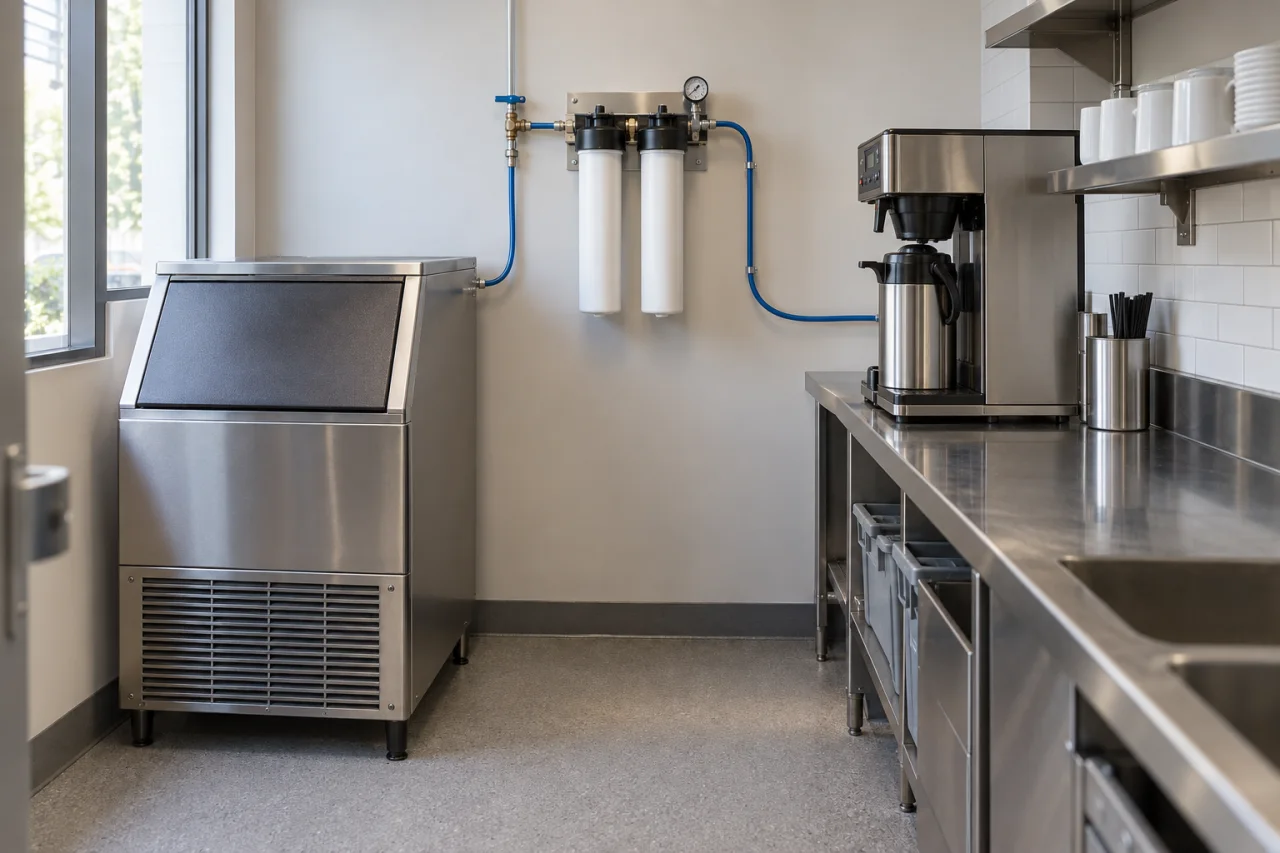
The equipment price is only one part of a commercial water treatment decision. A useful proposal should also explain what the system can deliver during your busiest period, what it consumes, and what happens when maintenance interrupts the water supply. For businesses comparing Commercial Water Treatment, the goal is a like-for-like review of installed scope, operating requirements and responsibilities—not simply the lowest equipment total.
1. Compare the same treatment scope
Before comparing equipment prices, define the job. Which appliances need treated water, what water conditions matter to them, and which outlets can remain untreated? Water Filtration for beverage taste is not automatically the same specification as treatment for hardness or dissolved solids.
Start with relevant water results, equipment model numbers and manufacturer water requirements. If proposals address different problems or different branches of the plumbing, their totals are not directly comparable. No single treatment technology removes every contaminant.
For a West End or Moore County business, identify whether the supply is municipal water or a private well without assuming either has a particular problem. The guide to planning treatment around your equipment can help organize the equipment inventory before requesting a proposal.
2. Separate peak demand from daily volume
Daily volume describes total water use over a day. Peak demand describes how quickly equipment needs water when several loads overlap. A coffee brewer, ice machine and other connected appliances may call for water together even when total daily consumption is modest.
Ask each proposer to state both the expected daily treated volume and the simultaneous service flow, with units. A gallon-capacity rating does not establish a system's flow capability.
Reverse osmosis adds another distinction: production rate is not necessarily delivery rate. Storage and distribution must support short bursts of demand while the system replenishes water. Ask how the proposed arrangement handles your busiest operating period and what assumptions it makes about incoming water conditions. Identify any planned equipment additions separately so today's requirements do not become an unexplained oversizing allowance.
3. Check pressure and treatment tradeoffs
A pressure reading taken while everything is idle does not show the pressure available during production. Static pressure describes the resting supply; dynamic pressure describes conditions while water is flowing.
Ask how the proposal accounts for pressure at the equipment during simultaneous use. Compare the treatment system's operating requirements with those of the appliances downstream. Sediment accumulation can restrict a cartridge and reduce service pressure, so the discussion should cover operation between changes—not only with new filters.
The following comparison highlights different cost drivers. These options can be combined; they are not interchangeable solutions or a ranking from cheapest to best.
Treatment options: what to compare and where each has limits
| Option | When it may fit | Operating-cost questions | Important limitation |
|---|---|---|---|
| Cartridge filtration | A specific sediment, taste, odor or certified reduction need | Exact replacement cartridges, change triggers and labor | A taste-and-odor cartridge is not a universal contaminant treatment. |
| Ion-exchange softening | Reducing calcium and magnesium hardness | Salt, regeneration water, drain arrangements and maintenance | Softening does not replace treatment for unrelated contaminants. |
| Reverse osmosis | Applications needing reduced dissolved solids | Pretreatment, membranes, reject water and storage or delivery needs | Production and service flow depend on the system and operating conditions. |
4. Price cartridge consumption, not just cartridges
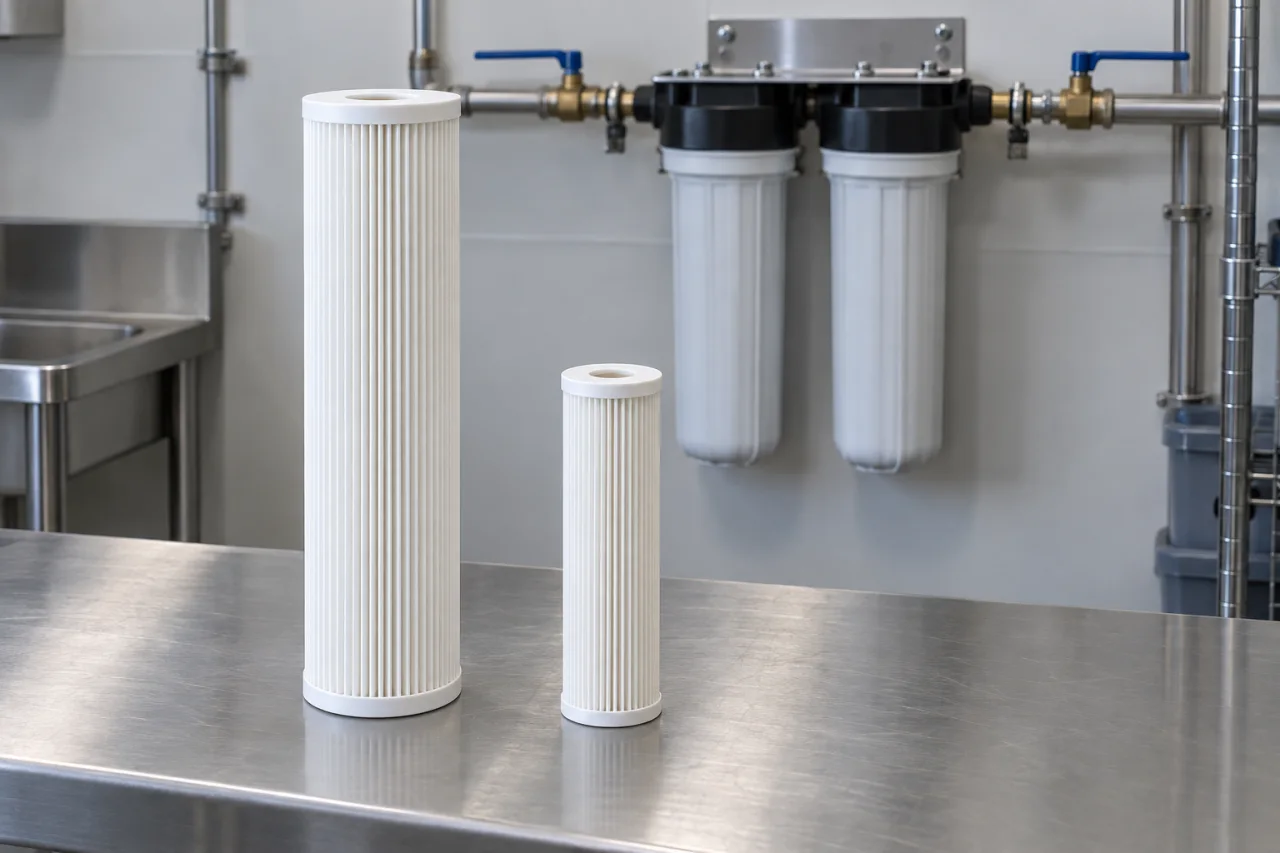
A rated cartridge capacity is not a promise of a fixed number of months at your business. Replacement can be driven by treated volume, sediment loading, inadequate flow or a manufacturer-specified time interval.
Request the exact replacement part numbers and quantities. Confirm whether multiple cartridges must be changed together, whether prefilters have a separate schedule, and what flushing is required after replacement. A low advertised cartridge price is not the complete cost if the assembly requires several elements and a service visit.
Ask who buys and stores consumables, whether substitutions are permitted under the system's instructions, and how replacement availability will be checked. Keep a simple record of changes and the reason for each one. Repeated early plugging deserves investigation rather than an assumption that every future change will follow the original estimate.
5. Include regeneration in the operating budget
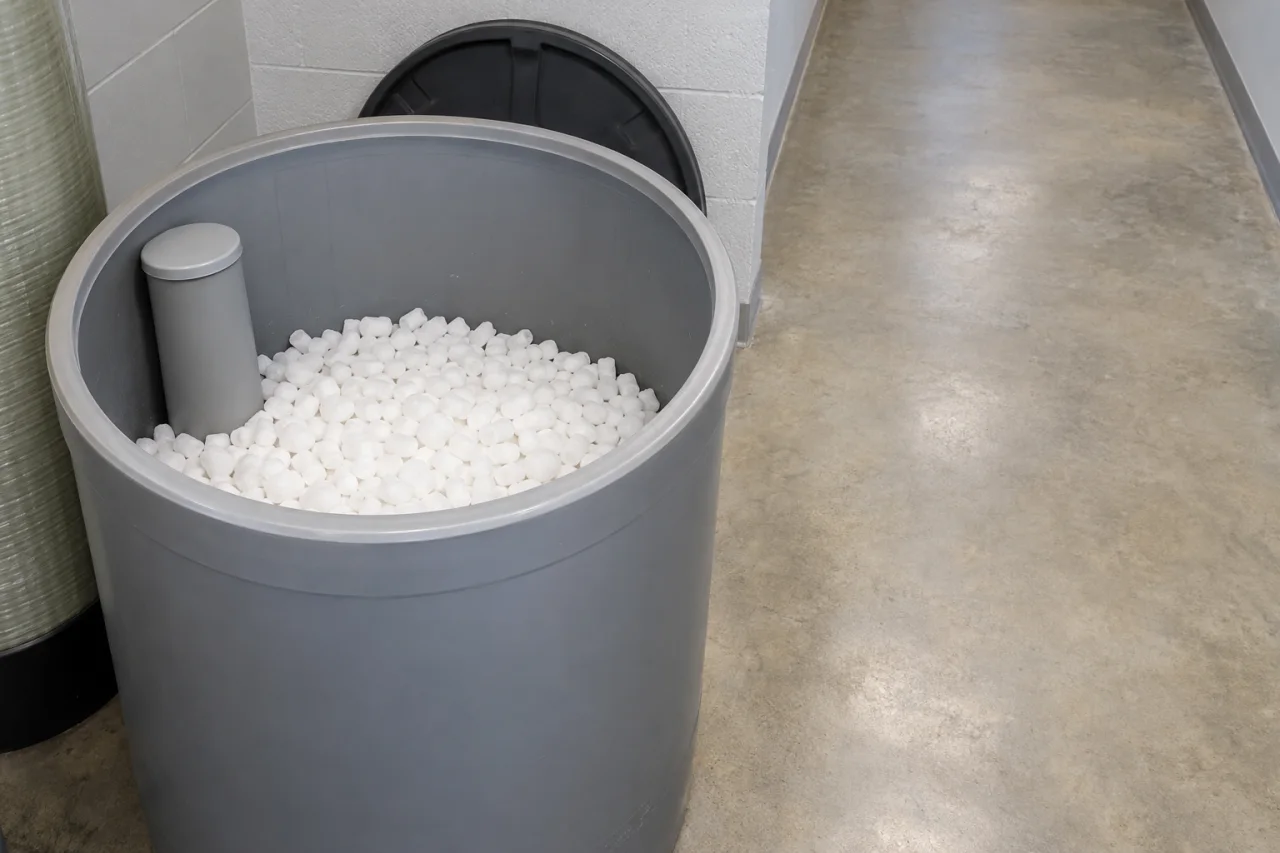
A salt-based softener restores its treatment capacity through regeneration, which uses salt and water. Its operating budget therefore needs more than a salt allowance: include replenishment labor, regeneration water and applicable wastewater charges.
Ask for the proposed operating settings and the basis for the expected regeneration frequency. Hardness and treated volume affect the load placed on the resin; a headline capacity without its operating assumptions is incomplete. The water softener sizing guide explains that relationship in more detail.
Demand-initiated controls can match regeneration to use more closely than a fixed schedule, but controls alone do not establish a site's costs. Ask what happens if equipment needs water during regeneration, whether untreated water can pass through, and whether the proposed configuration meets the business's continuity requirements. Confirm suitable drainage before approving the layout.
6. Make maintenance access and downtime visible
A unit can fit on a wall and still be difficult to maintain. Review clearance for removing cartridges, opening tanks and reaching shutoffs. Include space to carry salt or replacement parts without moving heavy kitchen equipment.
Ask for a realistic maintenance interruption plan. Identify which appliances lose water, who may isolate the system, and what must happen before equipment returns to use. For sites that cannot pause, request a separately explained continuity option rather than assuming that extra cartridges provide redundancy.
A bypass is not equivalent treatment. Ask whether downstream equipment may receive untreated water and under what conditions. Also establish a restart plan for extended closures; flushing, sanitizing or replacement needs should follow the applicable manufacturer instructions, not an improvised reopening routine.
7. Read the water conditions behind the warranty
Request the current installation manual and warranty for both the treatment equipment and the appliances it supplies. Ask whether either specifies incoming water conditions, pretreatment, approved replacement parts or maintenance requirements.
For example, a commercial reverse-osmosis specification can set limits for hardness, iron, turbidity and other feed-water characteristics. Those limits belong to that model; they are not universal acceptance criteria.
Equipment warranties can also exclude damage associated with adverse operating conditions or missed cleaning and maintenance. Hoshizaki's warranty for its flaker and dispensing cubelet machines includes such exclusions. That does not determine another product's coverage. Ask the proposer to identify applicable requirements and any unresolved compatibility questions in writing, without treating a filtration purchase as a warranty guarantee.
8. Use one proposal and operating-cost checklist
Ask every proposer to use the same comparison period and operating assumptions. Separate initial installed cost from recurring expenses, and distinguish scheduled maintenance from corrective repairs. Keep the business impact of an interruption visible even if it cannot be priced confidently.
Treat annual consumable quantities as estimates tied to stated usage and water conditions—not fixed promises. Ask what would change the estimate and how an unexpected early replacement would be handled.
For a scoped discussion with The Water Knight about Commercial Water Treatment, bring your equipment list, available water results and operating schedule. Water treatment visits are by arrangement. The most useful proposal is one that makes its inclusions, assumptions and responsibilities clear enough to compare.
- List the treatment goal, connected appliances, exact equipment models and water-quality assumptions.
- State daily treated volume, simultaneous flow and required pressure at the equipment.
- Separate equipment, installation, plumbing alterations, drainage, electrical work and startup inclusions or exclusions.
- Identify every consumable, quantity, replacement trigger and estimated purchasing frequency.
- Clarify who supplies consumables and who performs replacements, flushing and other required maintenance.
- Itemize applicable labor, travel, testing, salt, water, wastewater and power assumptions.
- Describe maintenance access, affected equipment, interruption planning and any separately priced continuity option.
- Provide manuals, warranty terms and responsibility for ongoing records.
Questions & answers
Can two systems with the same gallon capacity serve different equipment loads?
Yes. Total treatment capacity and service flow rate describe different limits. Compare how much water each system can treat with how quickly it can deliver water at the pressure required by connected equipment.
Can we budget cartridge changes using daily water volume alone?
Use volume as a starting estimate, not a guaranteed replacement schedule. Sediment loading, pressure loss and the manufacturer's time-based replacement instructions can require an earlier change. Confirm the exact cartridge and the conditions behind its capacity rating.
Is a larger treatment system always the better investment?
No. Unnecessary capacity can increase purchasing and maintenance costs. Size the proposal around documented treatment needs, peak demand and a stated allowance for growth rather than choosing the largest available system.
Can treatment be bypassed while maintenance is performed?
Only if the system design, downstream equipment requirements and water conditions permit it. A bypass does not provide equivalent treated water. Ask which equipment must stop and whether another approved supply arrangement is needed.
Does installing a filter guarantee equipment warranty coverage?
No. Review the warranty and installation manual for the exact equipment model. Water conditions, installation, maintenance and the cause of a failure may affect coverage; a filter purchase alone does not establish eligibility.
Sources & further reading
- EPA WaterSense Guide to Selecting Water Treatment Systems
Treatment selection by identified need; point-of-use versus point-of-entry scope; avoiding unnecessary oversizing; technology limitations; and demand-initiated regeneration and efficiency considerations. Supports the scope section, option comparison and proposal-planning questions.
- Pentair Everpure FC Series Installation, Operation & Maintenance Guide
Distinct capacity and flow specifications; static versus dynamic pressure; sediment-related pressure loss; accessible mounting and cartridge clearance; coordinated cartridge replacement; and interruption of the equipment water supply during cartridge changes.
- Pentair: Replacing Your Commercial Water Filter Cartridge
Water quality and usage affect cartridge replacement frequency; sediment can increase replacement needs; declining flow and pressure during operation are relevant maintenance indicators; extended shutdowns require manufacturer restart guidance.
- EPA WaterSense: Cation Exchange Water Softeners
Ion-exchange softeners remove calcium and magnesium and consume salt and water during regeneration. Supports the softening comparison and recurring-resource budget discussion.
- Penn State Extension: Water Softening
Hardness and water volume determine softening load; regeneration restores resin capacity; timed and demand-controlled regeneration differ; maintenance and pretreatment affect system operation. Household pricing and sizing examples are not applied to commercial proposals.
- Pentair Everpure MRS-600HE-II Reverse Osmosis System Specification Sheet
A model-specific commercial RO example distinguishes daily production from service flow, notes storage-pressure and line-size effects, identifies replacement elements and maintenance needs, and specifies feed-water chemistry limits. Its numerical specifications are not generalized to other systems.
- Hoshizaki Manufacturer's Limited Labor and Parts Warranty: Flakers and Dispensing Cubelet Machines
The warranty for Hoshizaki flaker and dispensing cubelet machines conditions coverage on proper installation and maintenance and excludes specified damage from adverse operating conditions, external supply problems and failure to clean or maintain. Supports the warranty example only, not a coverage determination.
Prepared and automatically checked on . Conditions, costs and requirements can change. Ask about the details that apply to your situation.
Continue reading
Helpful next reads
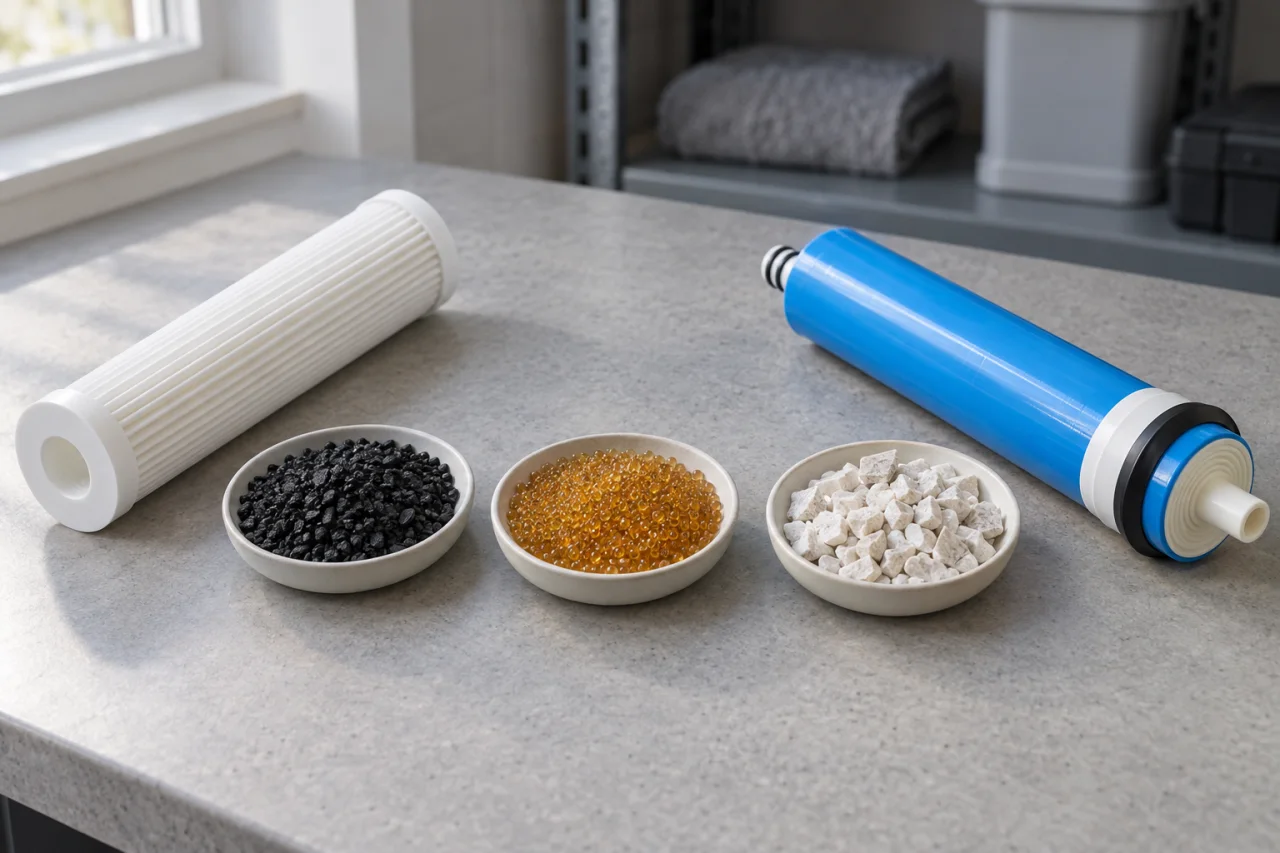
Carbon, Resin, Membranes and Mineral Media: A Water Treatment Options Guide
The material inside a treatment system determines its job. Compare carbon, resin, membranes and mineral media by water results, flow needs, upkeep and discharge.
Whole-House or Under-Sink Filtration: Where Should Treatment Happen?
Whole-house treatment is not automatically the better choice. Compare where water is used, what needs reducing and how much maintenance each option requires.
What Drives the Cost of Whole-House Water Filtration?
Two whole-house filtration proposals may solve different problems. Compare water results, treatment flow, installation requirements and replacement expenses before choosing.