
Practical guides · cost
Water Softener Sizing: How Demand and Hardness Affect Cost
A useful softener proposal connects measured hardness, daily consumption and peak flow to a specific model, installation plan and realistic operating estimate.
What you’ll learn
- Size around measured hardness and actual treated-water demand, not household headcount alone.
- Evaluate peak service flow separately from treatment capacity.
- Compare usable grain capacity at a stated salt dose, not an isolated capacity headline.
- Ask for itemized installation scope and operating estimates with clear assumptions.
- Choose a location that supports drainage, salt loading and future maintenance.
A water softener’s cost is not determined by the number of people in a home alone. Hardness determines the mineral load in each gallon; daily consumption determines how much water needs treatment; peak flow describes how quickly that water is needed. For homeowners in West End and across Moore County, the practical goal is to compare equipment, installation work and ongoing consumption together. Here is how to make that comparison without relying on a generic household-size chart or an unsupported monthly cost.
1. Start with measured hardness, not neighborhood assumptions
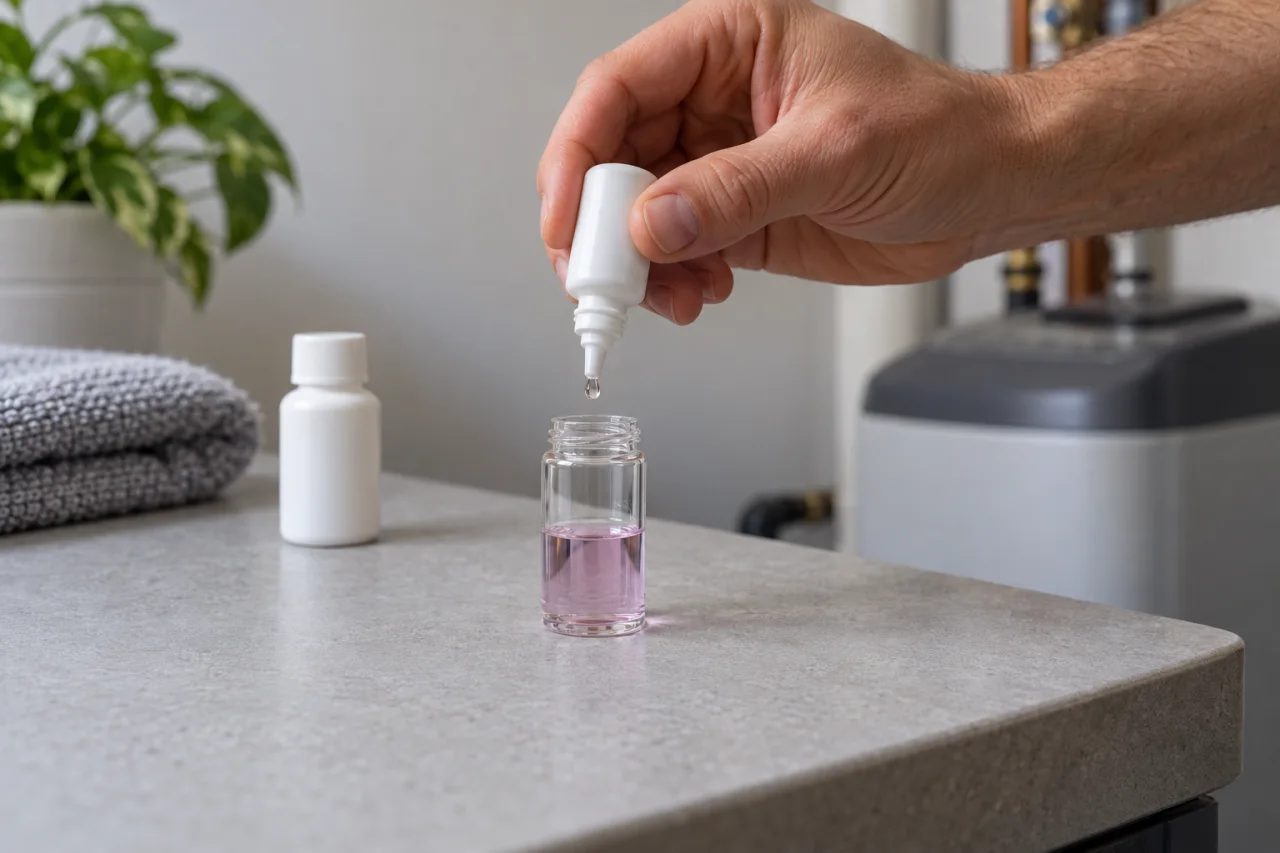
Hardness describes dissolved calcium and magnesium, commonly reported as milligrams per liter, parts per million or grains per gallon. For hardness calculations, mg/L and ppm are equivalent; one grain per gallon is approximately 17 mg/L. Confirm the units before comparing a test result with a controller setting.
Start with water testing rather than assuming every West End or Moore County property has the same hardness. A private well and a municipal connection should not receive identical settings simply because they serve similar homes.
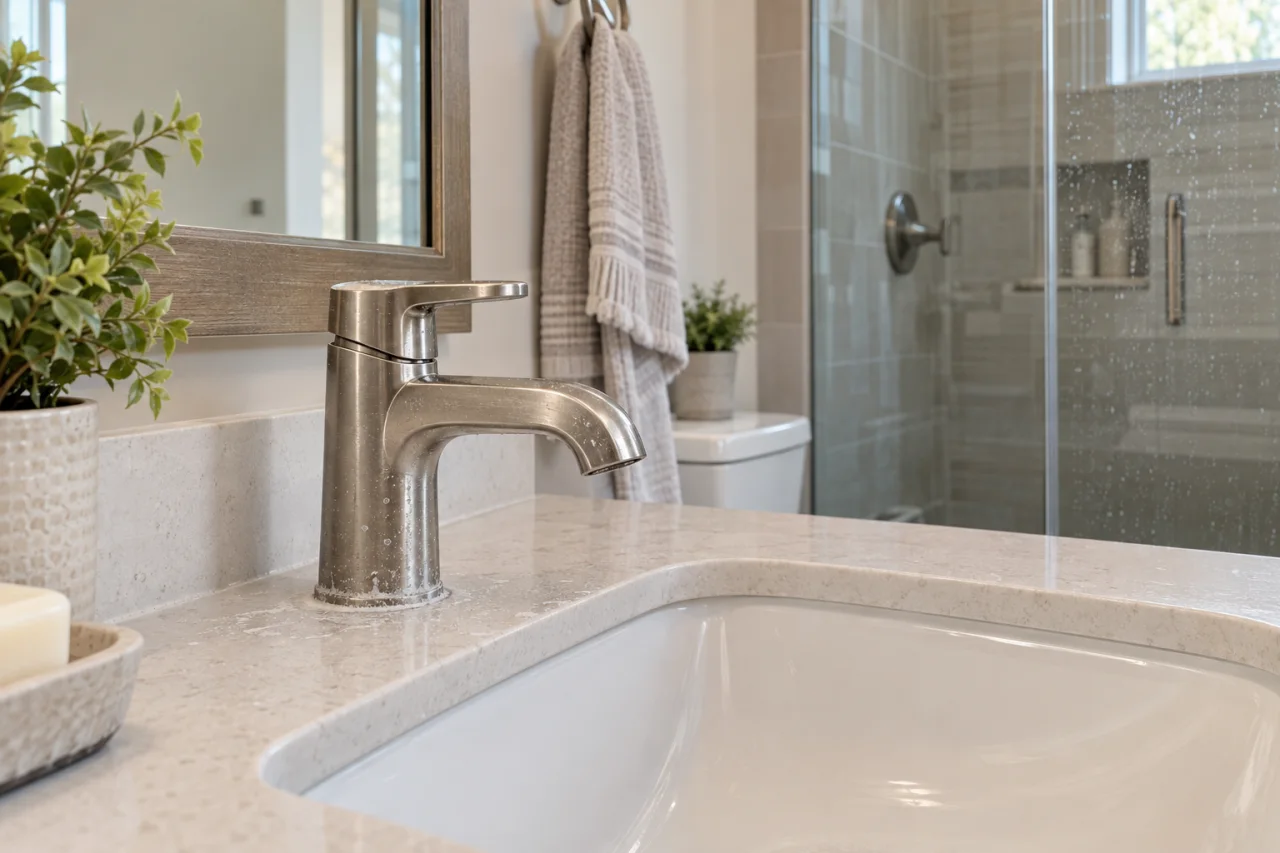
Hardness is also different from iron, sediment or microbial contamination. A hardness reading alone cannot establish the complete treatment plan. If the goal is scale control without removing hardness minerals, review water softening versus salt-free scale control before comparing equipment prices.
2. Translate daily water use into a treatment load
The basic sizing relationship is straightforward: gallons softened per day multiplied by hardness in grains per gallon equals the daily hardness load in grains. Usable treatment capacity divided by that load gives a starting estimate of days between regenerations.
For illustration only, 200 gallons per day at 10 grains per gallon creates a load of 2,000 grains daily. A hypothetical usable capacity of 20,000 grains would cover about ten days before reserve allowances and control settings. Double the hardness at the same water use, and that interval roughly halves.
These are arithmetic examples, not a recommended equipment size or regeneration schedule. Review actual consumption where available, distinguish indoor demand from irrigation, and explain seasonal occupancy. Household headcount cannot capture long showers, frequent laundry or extended periods with guests.
3. Check peak flow separately from grain capacity
Capacity answers how much hardness a softener can remove between regenerations. Service flow answers how quickly water can pass through it under specified conditions. A home can have modest daily consumption but substantial short-term demand when showers and appliances run together.
For Impression Plus Series® equipment, ask for the exact model’s service-flow rating and the associated pressure loss. Do not interpret a maximum flow figure as a promise of unchanged pressure at every fixture. The supply, piping and other treatment equipment belong in the discussion too.
Use this comparison to keep different measurements from being treated as interchangeable.
Different sizing measurements answer different questions; none replaces the others.
| Measurement | Units or rating | Useful for | Important limitation |
|---|---|---|---|
| Hardness | Grains per gallon or mg/L | Establishes the mineral load per gallon | Does not describe household consumption |
| Usable capacity | Grains at a stated salt dose | Helps estimate water treated between regenerations | Changes with operating settings |
| Service flow | Gallons per minute with pressure loss | Helps evaluate simultaneous fixture demand | Does not establish days between regenerations |
| Regeneration drain flow | Gallons per minute | Helps assess discharge requirements | Is not total water consumed per cycle |
4. Ask for a model-and-settings proposal
The Water Knight offers Impression Plus Series® water softeners. The manufacturer describes metered controls that adjust regeneration around water-use patterns, along with diagnostic history and optional cabinet designs. Those features are useful, but the series name is not a complete specification.
The specification sheet lists different capacities at minimum, medium and maximum salt settings. Consequently, a capacity figure without its salt dose is an incomplete comparison. Higher capacity at a higher dose should not be mistaken for the same operating efficiency.
Cabinet and separate-tank layouts also deserve a practical comparison. A compact footprint may help in a smaller utility space, but ask how the proposed layout accommodates salt loading and servicing. Request the following information in writing.
- Exact model designation and applicable specification sheet.
- Proposed usable grain capacity and pounds of salt per regeneration.
- Service-flow rating with its associated pressure loss.
- Estimated total regeneration water use and expected cycle frequency.
- Tank dimensions, salt-loading access and service access.
5. Understand what triggers regeneration
Regeneration restores the resin’s ability to exchange hardness minerals. It consumes salt and water, making frequency a central operating-cost factor.
Demand-initiated regeneration uses measured demand rather than relying solely on a fixed calendar schedule. That can avoid unnecessary cycles during low-use periods. It does not mean every metered softener will have identical consumption: hardness load, usable capacity and settings still matter.
Ask how reserve capacity and any day override affect the estimate. A day override can require regeneration even when the calculated gallon allowance has not been exhausted. Also ask what water reaches fixtures during regeneration; the Impression Plus manual describes untreated water passing to the building during that cycle.
Choose a suitable regeneration window around actual household habits rather than assuming everyone is asleep at the same hour.
6. Separate equipment cost from installation scope
Equipment is only part of the installed cost. Request a proposal that separates the softener from plumbing alterations, drain work, electrical provisions and any additional treatment recommended from test results.
The Impression Plus manual calls for a firm, level installation surface, accessible salt storage, suitable electrical power and protection from freezing. It also requires an air-gapped drain arrangement and describes a separate gravity overflow route where overflow could damage the building.
Discuss the main-line location, the route to an appropriate drain, access to the bypass and whether outdoor branches should remain unsoftened. Existing plumbing may make those choices simple or require alterations. Ask whether removal of old equipment, startup, programming and an owner handover are included, rather than assuming they are.
For a property using septic, request a discharge plan appropriate to that property and confirmation of applicable requirements before installation.
7. Build a realistic running-cost comparison
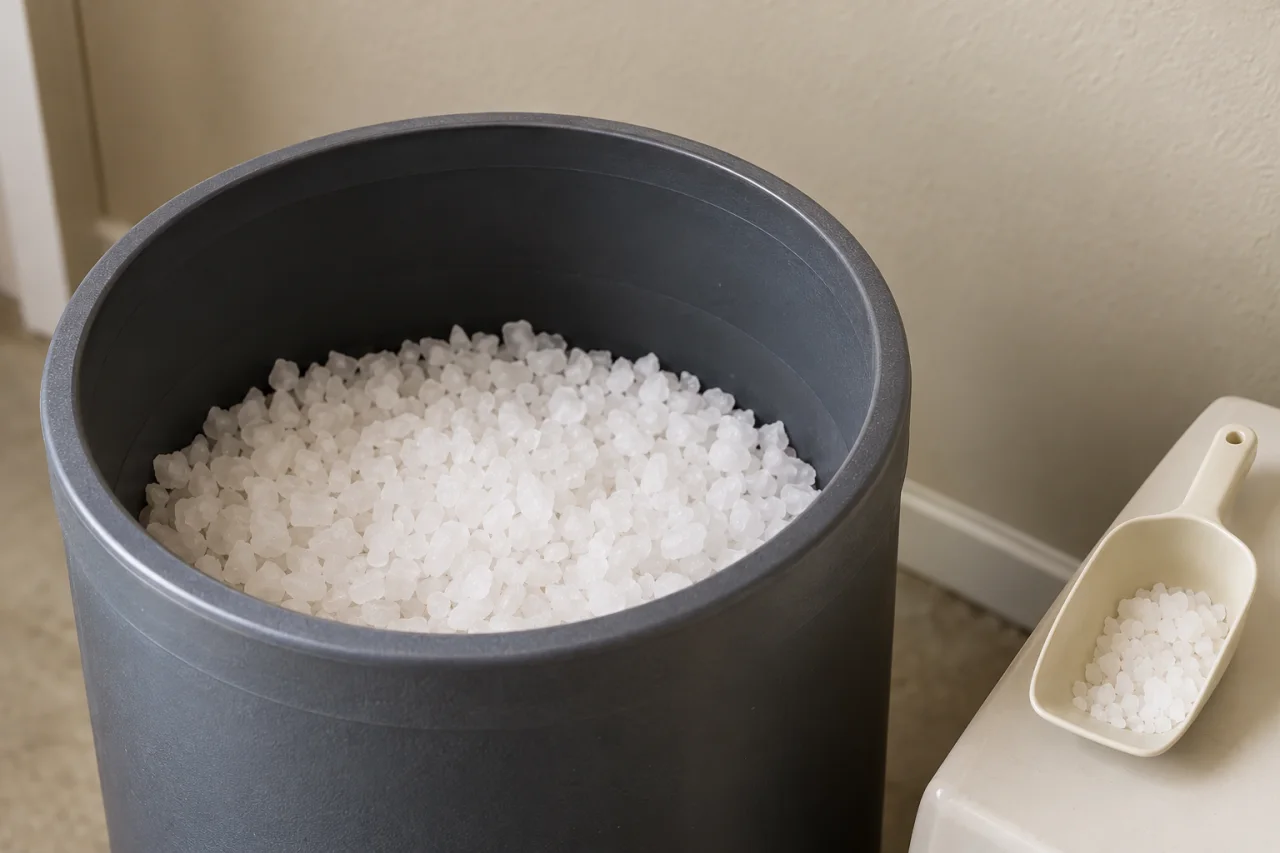
Ask for an operating estimate built from stated assumptions, not a universal monthly allowance. Salt consumption can be estimated from pounds per cycle multiplied by expected cycles. Regeneration water can be estimated from gallons per cycle multiplied by those same cycles. Apply your own salt purchase cost and applicable utility charges.
For a private well, water production still involves pumping even without a municipal water bill. Ask separately about electricity and maintenance rather than treating either as included in a salt estimate.
Keep laboratory efficiency ratings distinct from projected household consumption. Manufacturer documentation notes that actual efficiency varies with application conditions. A lower equipment price is not necessarily a lower ownership cost, but neither does a larger tank automatically pay for itself. Compare proposals using the same hardness, consumption and operating assumptions.
8. Plan for ownership before choosing the equipment
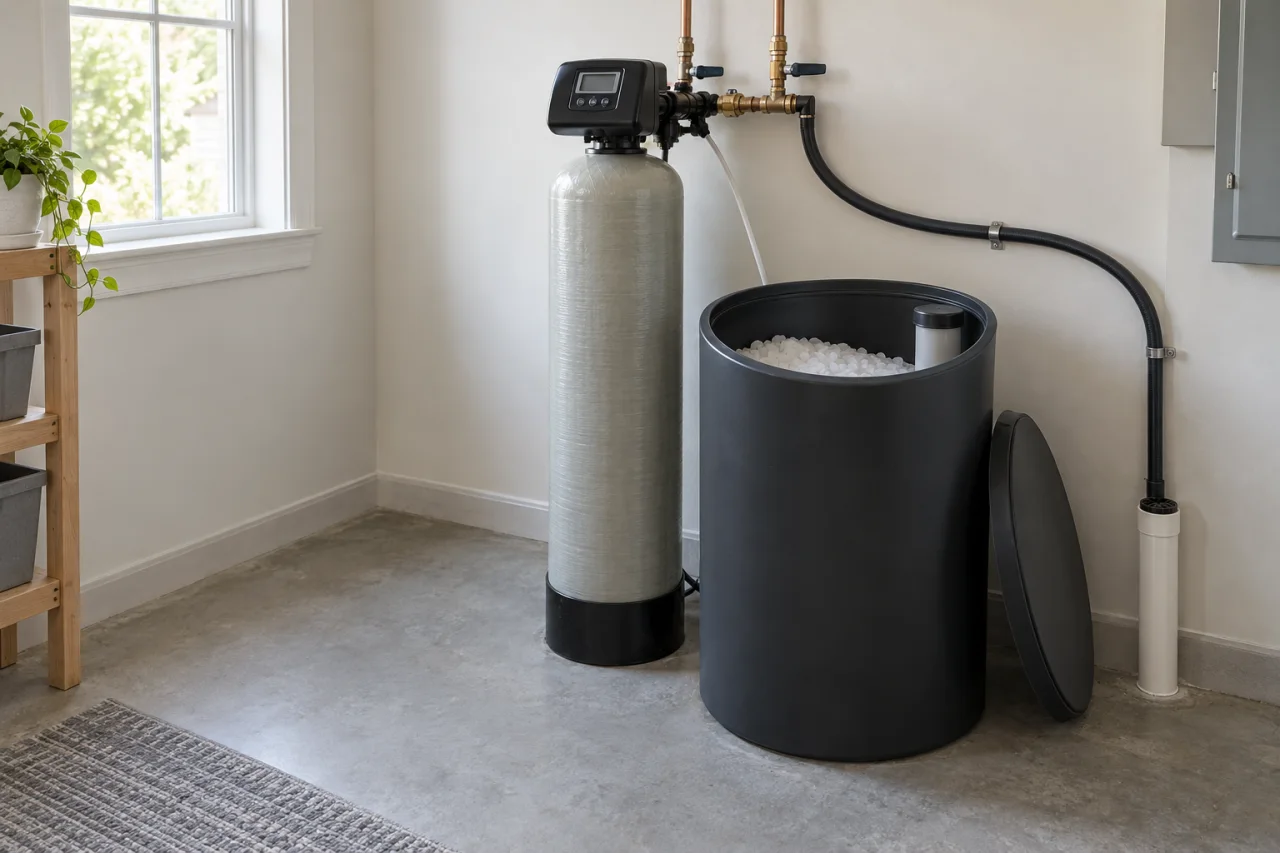
Maintenance belongs in the purchase decision. Plan for periodic salt checks and brine-tank care, and ask what professional service is recommended for the selected model. A salt bridge can leave salt visible while interfering with normal brine preparation.
Keep a simple record of salt additions and unusual changes in water use. Investigate unexpected consumption or returning hardness symptoms rather than repeatedly changing controller settings. Our guide to salt, regeneration and maintenance explains the questions worth raising.
For a Water Softener discussion with The Water Knight, bring your test results, usage information and location photographs. Water treatment visits are by arrangement. The useful next step is a proposal connecting your measured conditions to a specific model, installation scope and operating estimate—not a tank selected from household size alone.
Questions & answers
Can a softener be sized from the number of people in the home?
Headcount is a starting estimate, not a complete specification. Measured hardness, the volume routed through treatment and simultaneous fixture use all matter. Two equally sized households may need different capacity or flow performance.
Will a larger softener always use less salt?
No. Salt use depends on the hardness removed, programmed capacity, salt dose and regeneration frequency. Oversizing does not automatically improve efficiency. Compare the proposed operating settings and estimated consumption, rather than tank size alone.
Does the regeneration drain-flow rating tell me gallons used per cycle?
No. A maximum drain-flow rating describes a flow rate, not the total volume discharged. Request total regeneration water use for the specific model and programmed cycle sequence.
Does a water softener make well water safe to drink?
Hardness treatment is not a complete drinking-water safety treatment. The Impression Plus Series® documentation states that microbiologically unsafe water requires adequate disinfection before or after the system. Other concerns require testing and treatment selected for the specific substance.
What should I bring to a sizing discussion?
Bring water-test results, available water-use records, information about fixtures that run together and photographs of the proposed equipment location. Mention outdoor watering, seasonal occupancy and any existing treatment equipment.
Sources & further reading
- Penn State Extension: Water Softening
Hardness units and approximate conversion; daily hardness-load arithmetic and the relationship between capacity, water use and regeneration interval.
- EPA WaterSense: Guide to Selecting and Maintaining a Water-Efficient Water Softener
Sizing from hardness and water consumption; excluding irrigation demand; avoiding oversizing; regeneration water use, installation planning and checking local restrictions.
- Water-Right: Impression Plus Series® Water Softeners
Series-specific metered regeneration controls, diagnostic features and optional cabinet design.
- Water-Right: Impression Plus Series® Specifications, revision May 2024
Model-specific capacity at different salt doses, service flow and pressure loss, regeneration drain flow, dimensions, laboratory-efficiency limitations and disinfection limitations.
- Water-Right: Impression Plus Series® Installation Instructions & Owner’s Manual
Site access, level surface, electrical and freeze-protection requirements; air-gapped drainage and separate overflow routing; day override and untreated water supplied during regeneration.
- Pacific Northwest National Laboratory: Water Softeners
Demand-initiated versus fixed-calendar regeneration and the distinction between general certification and voluntary water- and salt-efficiency criteria.
- EPA: Cation Exchange Water Softeners
Ion exchange, salt and water use during regeneration, and the absence of a WaterSense product label for water softeners.
- EPA WaterSense: Home Maintenance
Periodic salt checks, salt bridges, brine-tank cleaning, professional service and regeneration programming based on incoming hardness or demand.
Prepared and automatically checked on . Conditions, costs and requirements can change. Ask about the details that apply to your situation.
Continue reading
Helpful next reads
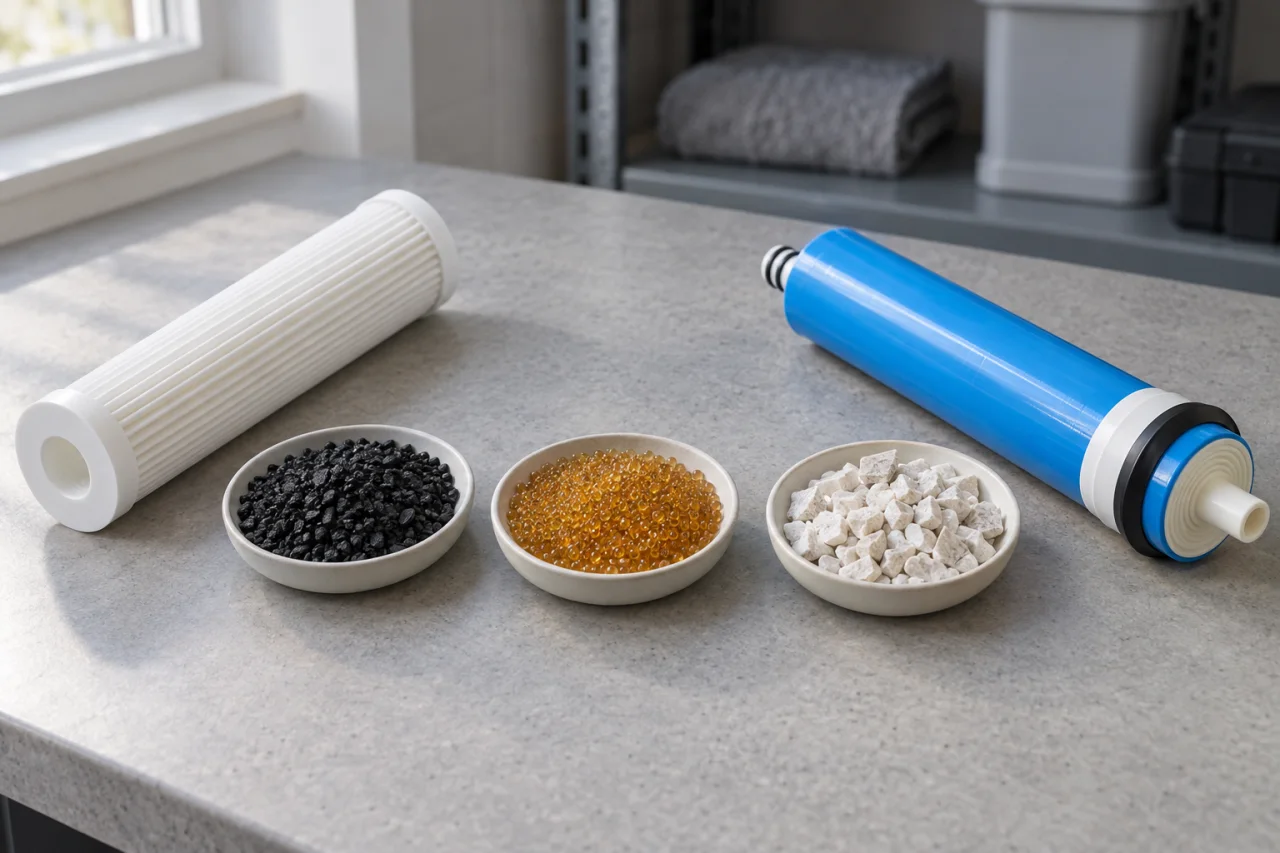
Carbon, Resin, Membranes and Mineral Media: A Water Treatment Options Guide
The material inside a treatment system determines its job. Compare carbon, resin, membranes and mineral media by water results, flow needs, upkeep and discharge.
Water Softening vs. Salt-Free Scale Control: What Actually Changes?
A salt-free scale-control device is not simply a softener without the salt. Learn which results each approach can deliver—and what to check before choosing.
Water Softener Care: Salt, Regeneration and Signs to Investigate
A practical owner checklist for approved salt, brine-tank changes, display alerts and hardness testing—with clear boundaries between routine checks and qualified service.