Practical guides · comparison
Water Softening vs. Salt-Free Scale Control: What Actually Changes?
A salt-free scale-control device is not simply a softener without the salt. Learn which results each approach can deliver—and what to check before choosing.
What you’ll learn
- Ion-exchange softeners remove hardness minerals; salt-free scale-control devices generally change scale behavior without removing those minerals.
- Scale reduction does not establish equivalent soap performance or spotless fixtures.
- Compare exact models, operating limits and claim-specific evidence rather than relying on the phrase salt-free.
- Include salt, regeneration water, replacement media, pretreatment and installation scope in the ownership comparison.
No—a salt-free scale-control device generally will not give you the same results as an ion-exchange water softener. A softener removes calcium and magnesium, the minerals responsible for hardness. Scale-control equipment typically leaves those minerals in the water while targeting how deposits form. Both may be considered for a scale concern, but only hardness removal directly delivers softer water. The practical choice depends on whether you want better soap performance, lower measured hardness, reduced scale formation or some combination of those results.
Hardness removal and scale control are different jobs
A conventional ion-exchange softener captures calcium and magnesium on resin and exchanges them for sodium or potassium. The treated water has lower hardness. Eventually, the resin needs regeneration: brine restores its exchange capacity, and the accumulated hardness minerals leave through the drain.
Salt-free scale-control equipment generally pursues a different result. Template-assisted crystallization, or TAC, encourages mineral crystals to form rather than removing the minerals from the water. Its purpose is to reduce their tendency to form adherent scale.
That distinction matters when judging results. A softener should deliver a measurable hardness reduction. A scale-control device should be evaluated against its documented scale-reduction claim and operating conditions. One result does not prove the other.
Start with a test and a specific goal
For a home in West End or elsewhere in Moore County, start with the water at that property rather than assuming a hardness level from the town name. Water Testing can establish a useful baseline; a utility may also have hardness information for its supply.
Match that result to your priorities. If reduced hardness and better soap performance are central, hardness removal is the relevant target. If your main concern is scale on equipment and you accept minerals remaining in the water, documented scale control may be worth comparing.
Taste, odors and unusual stains need their own investigation. Buying a hardness-treatment device first can leave the actual problem unresolved.
- Record untreated-water hardness and its units, commonly grains per gallon or milligrams per liter as calcium carbonate.
- Identify whether the concern is soap scum, scale on heated equipment, surface spotting or something unrelated to hardness.
- Check the proposed equipment’s water-quality requirements before comparing purchase prices.
- Consider peak household flow as well as average daily water use.
Compare three approaches without treating them as equivalents
Salt-free is not a single technology or a performance rating. The options below have different mechanisms and evidence. Compare the exact product, not just the category name.
TAC is included here as a comparison option, not as a statement that The Water Knight supplies it. Magnetic or electromagnetic devices also should not inherit claims made for TAC equipment.
Three treatment approaches and where their benefits stop
| Option | Potential benefit | Best-fit objective | Limitations and cost considerations |
|---|---|---|---|
| Regenerating ion-exchange softener | Removes calcium and magnesium; addresses hardness-related scale and soap interference. | Appropriate when measurable hardness reduction is the goal. | Requires regenerant, regeneration water and drainage. Operating expense depends on hardness, demand, settings and equipment efficiency. |
| Template-assisted crystallization scale control | Targets scale formation without adding regenerant salt or removing hardness minerals. | A comparison option when scale reduction, rather than softened water, meets the objective. | Requires compatible water chemistry and flow. Surface spotting can remain; media replacement and pretreatment can add expense. |
| Magnetic or electromagnetic scale-control device | Marketed to reduce scale without conventional brine regeneration. | Consider only with convincing evidence for the exact application; it is not equivalent to hardness removal. | Research findings vary, and effectiveness remains disputed. Do not treat a lower purchase price as proof of equivalent results. |
Soap, spotting and scale need separate expectations
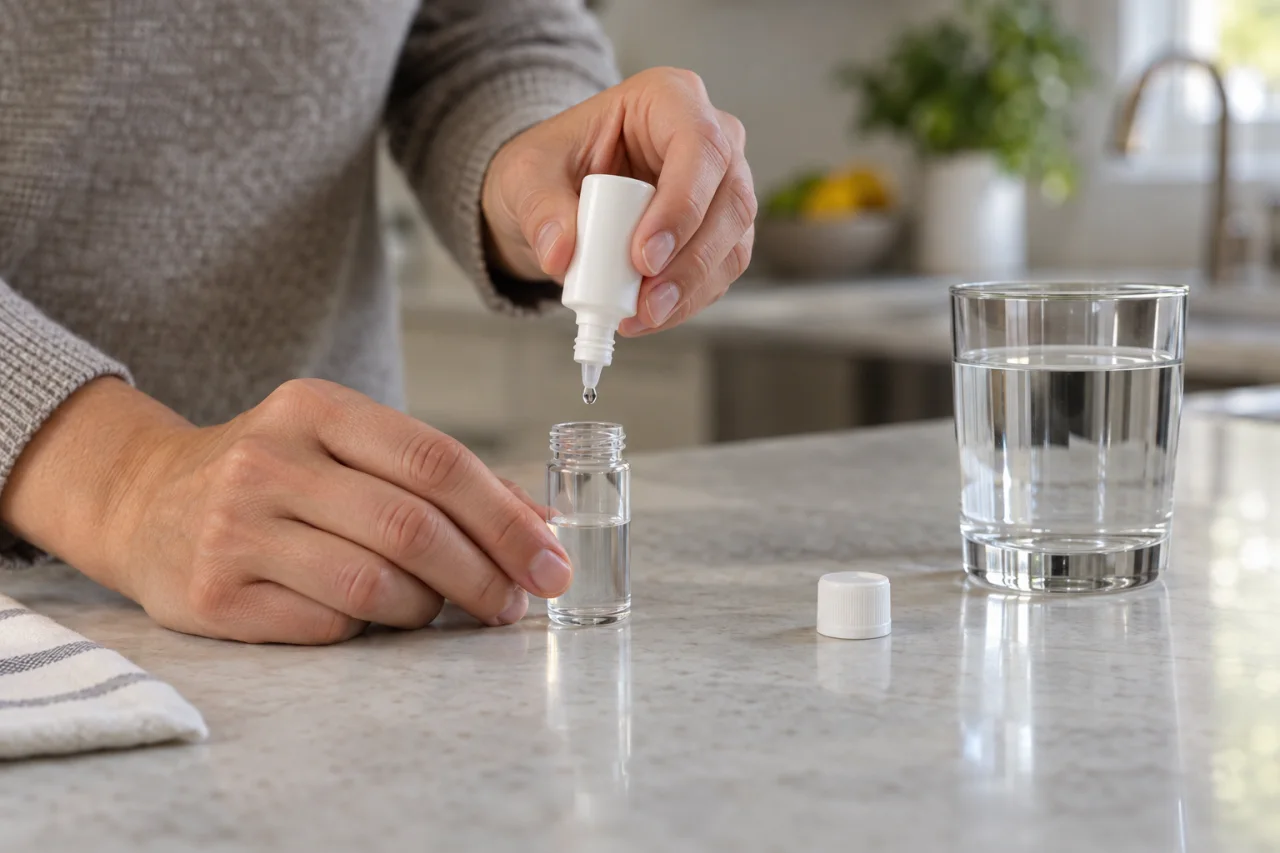
Hardness minerals interfere with soap, which is why a Water Softener can be relevant when soap film and poor lather are the main complaints. A claim about reduced scale inside a heater does not establish the same benefit at the sink or in the laundry.
Spotting is another separate outcome. The manufacturer guidance for the TAC system referenced here acknowledges that external spotting can occur. Minerals have not disappeared simply because their scale-forming behavior has changed.
Avoid making spotless glass the sole acceptance test for any whole-house system. Instead, ask what result the proposal actually covers: lower hardness, reduced scale deposition, improved soap performance or fewer visible deposits. These are related concerns, but not interchangeable promises.
Compare salt, water use and upkeep—not just tank price
An ion-exchange softener uses salt and water during regeneration. Its ongoing consumption depends on incoming hardness, household use, usable capacity and regeneration design. Ask for estimates based on your water and demand, not a universal monthly figure.
Demand-initiated regeneration uses measured consumption or hardness information to trigger regeneration instead of relying only on a fixed calendar. That can avoid unnecessary cycles during periods of lower use. Ask whether the proposed model has a verified salt-and-water efficiency rating in addition to its basic softener certification.
The TAC equipment referenced here does not use regeneration salt, backwashing water or electricity during operation. That does not make ownership cost-free: its media requires replacement, and water conditions may call for pretreatment. Other salt-free technologies may have different operating requirements.
Check operating limits and what the quote includes
A product’s operating envelope is as important as its advertised benefit. The referenced TAC specifications set limits for hardness, pH, temperature, pressure, flow and several substances in the incoming water. Excess iron or manganese can coat the media and reduce effectiveness; sediment may require pretreatment. Those limits belong to that product, not every salt-free device.
Before purchasing, request a written proposal identifying the equipment model, required pretreatment, installation scope and future consumables. For a regenerating softener, clarify the drain arrangement and any applicable wastewater or septic considerations. Access and the parts required also affect the installed price.
If taste, odor or a particular contaminant is part of the concern, discuss Water Filtration separately. Neither softening nor scale control should be assumed to solve every water-quality issue.
Ask what the certification actually proves
NSF/ANSI 44 addresses residential cation-exchange water softeners, including softening capacity and other performance requirements. Salt-and-water efficiency is an elective claim, so confirm it separately rather than assuming every certified model has the same efficiency.
For scale control, look for evidence that actually measures scale reduction. Certification concerning materials or lead content does not, by itself, establish hardness removal or anti-scale effectiveness. Current consumer guidance also identifies IAPMO/ANSI Z601 as a standard to look for when evaluating scale-reduction devices.
A laboratory percentage needs context. Ask what was tested and under which conditions before treating it as a prediction for your home.
- What measured result will demonstrate success for my stated concern?
- Does the exact model have certification or independent testing for that result?
- Were test conditions comparable to my water chemistry, temperature and flow?
- What pretreatment, replacement media, salt and service costs should I plan for?
- What installation work and maintenance responsibilities are included or excluded?
Choose the outcome you need, then plan the upkeep
Choose ion exchange when you want lower measured hardness and the associated soap-performance benefits, and can accommodate regeneration and upkeep. Consider a documented salt-free scale-control option when scale reduction alone meets your goal and the water falls within its limits.
For existing softeners, Water Softener Care: Salt, Regeneration and Signs to Investigate explains the ownership questions to keep in view. Follow the model’s instructions for salt, cleaning and service; a tank with salt in it is not proof that treatment is working correctly.
The Water Knight provides water testing, softening and filtration for homes and businesses in Moore County. A useful starting point is to discuss what you have observed, arrange an appropriate assessment and review proposed work before proceeding. Water treatment visits are by arrangement.
Questions & answers
Will a salt-free scale-control device make my water soft?
Not if it works by conditioning minerals rather than removing them. Template-assisted crystallization, for example, targets scale formation without removing calcium and magnesium. Choose based on whether you need scale control or an actual reduction in hardness.
Will salt-free treatment give me the same soap performance?
Do not assume so. Hardness removal directly addresses the minerals that interfere with soap. A scale-reduction claim does not establish equivalent lather, rinsing or detergent performance. Ask for evidence supporting those specific claims.
Does using potassium chloride make a softener salt-free?
No. Potassium chloride is still a salt used to regenerate compatible ion-exchange equipment. It changes the regenerant, not the underlying treatment category. Follow the equipment instructions rather than substituting products without checking compatibility.
Will either option make untreated well water safe to drink?
Neither should be treated as a complete drinking-water safety system. Hardness treatment does not establish protection against bacteria or every chemical contaminant. Testing and treatment must address the particular concern.
Does salt-free mean maintenance-free?
No. Depending on the technology, upkeep can include media replacement, pretreatment-filter changes or electrical-component maintenance. Obtain the exact model’s maintenance requirements and replacement costs before purchasing.
Sources & further reading
- U.S. Environmental Protection Agency: Cation Exchange Water Softeners
Explains calcium and magnesium removal through sodium or potassium ion exchange, soap-related hardness concerns, and salt and water use during regeneration. Supports the ion-exchange comparison-table row and the central distinction between softening and conditioning. ([epa.gov](https://www.epa.gov/watersense/cation-exchange-water-softeners))
- Nebraska Extension: Drinking Water Treatment—Salt-Free Water ‘Softener’ Options
Supports testing before selection, hardness reporting units, TAC’s conversion rather than removal of minerals, limitations for other contaminants, and the varying evidence for magnetic treatment. Supports the TAC and magnetic comparison-table rows and cautions against assuming equivalent soap performance. ([extensionpubs.unl.edu](https://extensionpubs.unl.edu/publication/g2275/2026/pdf/view/g2275-2026.pdf))
- Watts: OneFlow Anti-Scale System Engineering Specifications
Product-specific primary specifications support TAC operation without salt, backwashing or electricity; media replacement; water-chemistry and flow limitations; possible pretreatment; and remaining external spotting. These specifications are not presented as universal limits or as equipment supplied by The Water Knight. ([watts.com](https://www.watts.com/dfsmedia/0533dbba17714b1ab581ab07a4cbb521/12457-source/638966489130000000/es-of744-844-948-1054-1252.pdf))
- NSF: Technical Requirements of NSF/ANSI 44
Defines the scope of NSF/ANSI 44, including softening capacity, rinse effectiveness, material safety and structural integrity, and identifies salt-and-water efficiency as an elective claim. Supports distinguishing performance claims from materials-related certification. ([nsf.org](https://www.nsf.org/newsroom_pdf/dwtu_nsf_ansi_44.pdf))
- EPA WaterSense: Guide to Selecting and Maintaining a Water-Efficient Water Softener
May 2026 consumer guidance supports sizing around hardness and demand, checking wastewater and septic considerations, verifying efficiency claims, following maintenance instructions, and looking for IAPMO/ANSI Z601 when assessing scale-reduction devices. ([epa.gov](https://www.epa.gov/system/files/documents/2026-05/ws-products-water-softener-guide.pdf))
- Pacific Northwest National Laboratory: Water Softeners
Explains hardness-related soap interference, resin regeneration, drain discharge, and demand-initiated versus calendar-based regeneration. Supports the discussion of avoiding unnecessary regeneration and comparing verified efficiency ratings. ([basc.pnnl.gov](https://basc.pnnl.gov/resource-guides/water-softeners))
Prepared and automatically checked on . Conditions, costs and requirements can change. Ask about the details that apply to your situation.
Continue reading
Helpful next reads
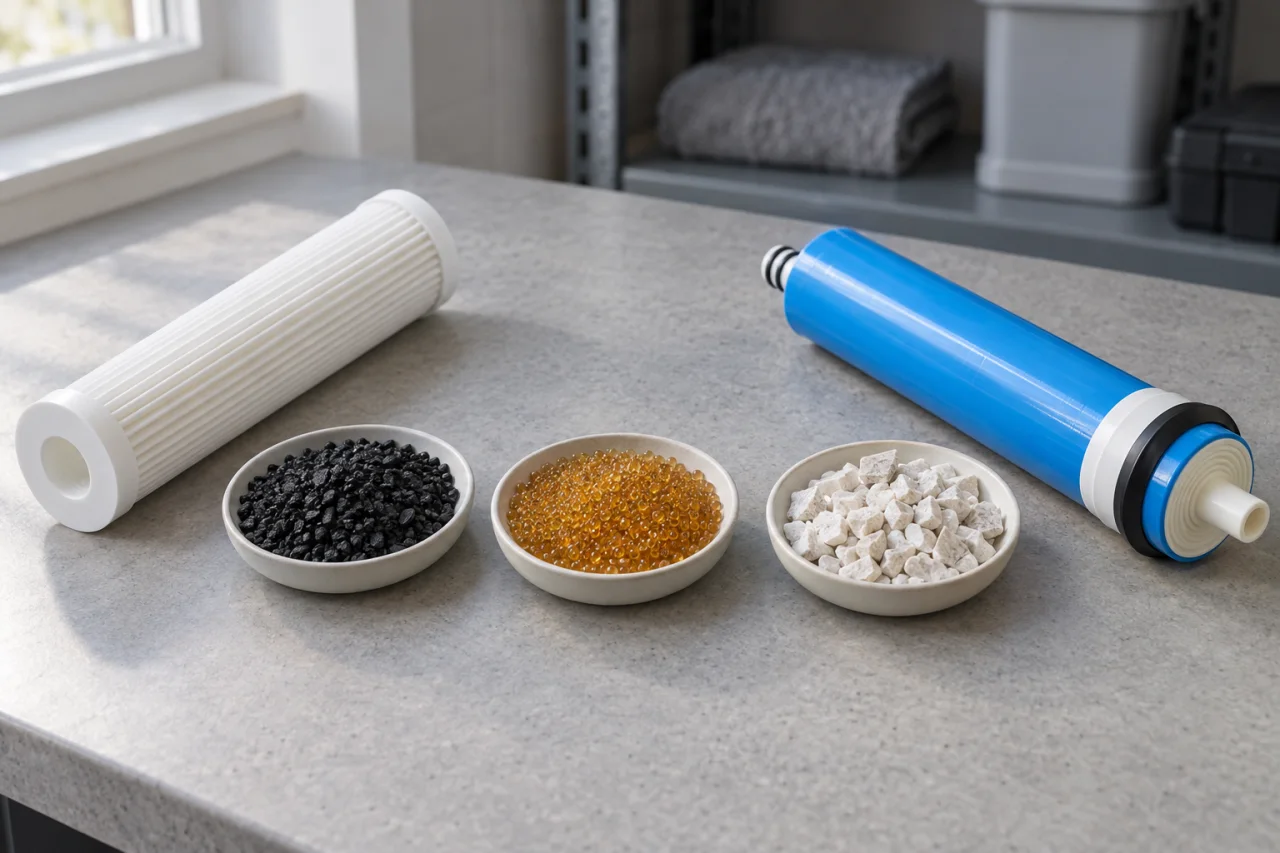
Carbon, Resin, Membranes and Mineral Media: A Water Treatment Options Guide
The material inside a treatment system determines its job. Compare carbon, resin, membranes and mineral media by water results, flow needs, upkeep and discharge.
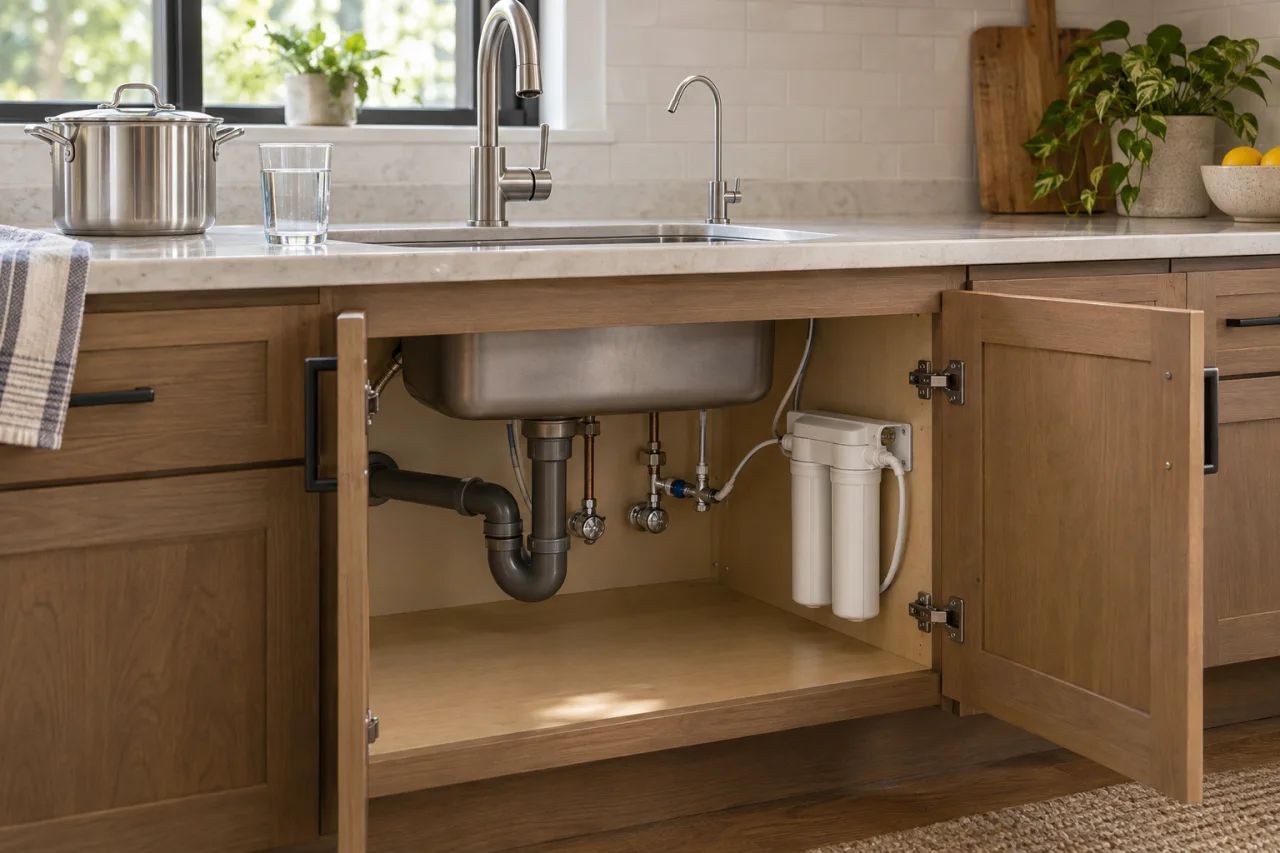
Whole-House or Under-Sink Filtration: Where Should Treatment Happen?
Whole-house treatment is not automatically the better choice. Compare where water is used, what needs reducing and how much maintenance each option requires.
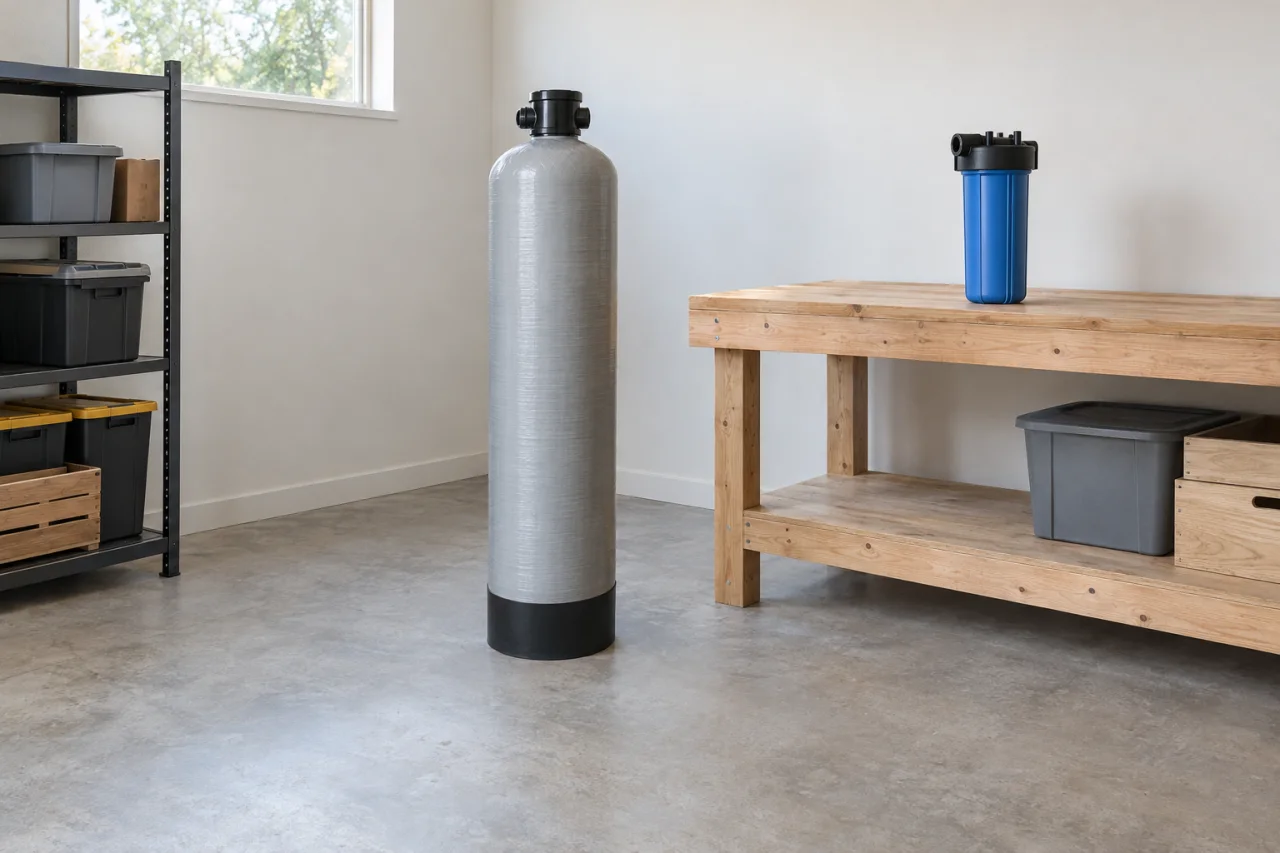
What Drives the Cost of Whole-House Water Filtration?
Two whole-house filtration proposals may solve different problems. Compare water results, treatment flow, installation requirements and replacement expenses before choosing.