
Practical guides · decision
Carbon, Resin, Membranes and Mineral Media: A Water Treatment Options Guide
The material inside a treatment system determines its job. Compare carbon, resin, membranes and mineral media by water results, flow needs, upkeep and discharge.
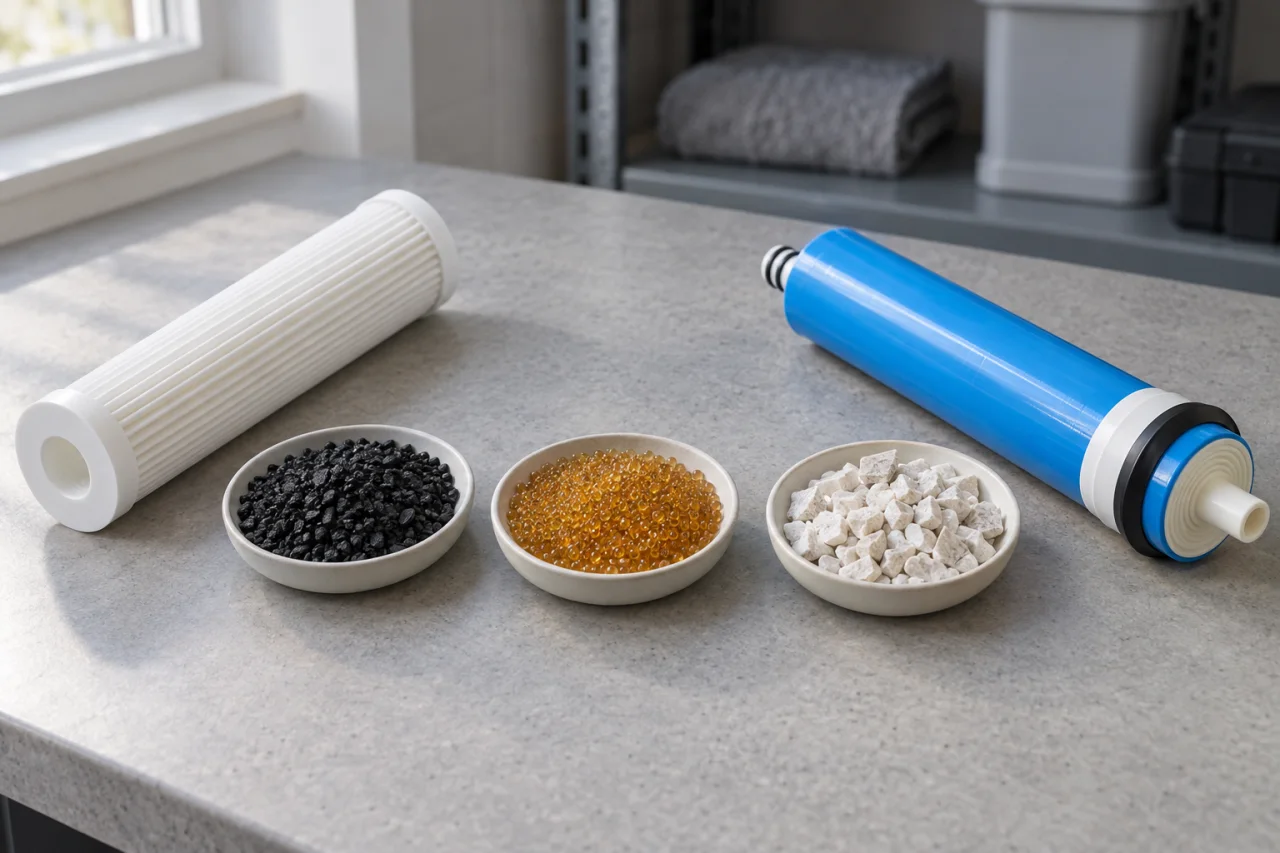
What you’ll learn
- Match each treatment stage to a measured problem; no single material addresses everything.
- Compare service flow, pressure loss and backwash requirements as well as treatment claims.
- Count cartridges, salt, replenishment media and discharge water among ownership obligations.
- Verify exact-model certification, approved replacements and written labor coverage.
Choosing water treatment is less about finding the most elaborate system and more about matching the material inside it to the problem in your water. Sediment cartridges, carbon, resin, membranes and mineral media work differently, and combinations may be needed. This guide helps you compare treatment targets, flow demands and maintenance before choosing equipment for your home or business. (extension.uga.edu)
Start with results and the water you actually need treated
Begin with the problem you need to solve, not the number of tanks or cartridges in a proposal. Ask which measured result each stage addresses, whether that concern affects the entire building or mainly drinking water, and what treated-water result is expected. Penn State recommends using testing to distinguish health-related concerns from aesthetic problems such as taste and staining. (extension.psu.edu)
For a West End or Moore County property, bring the actual water results and identify whether the supply is a private well or public water. Our guide to understanding the testing steps provides a useful starting point. Then consider whole-house or under-sink filtration: treatment location is a separate decision from treatment material. A kitchen system and a whole-building system need not solve the same problem. (extension.uga.edu)
Sediment cartridges: particle capture comes with a flow tradeoff
Sediment cartridges physically capture suspended material such as sand, silt and rust particles. They are not substitutes for treatment of dissolved hardness or dissolved chemicals. Their practical role may be protecting downstream equipment rather than making a contaminant-specific drinking-water claim. (extension.uga.edu)
Finer filtration is not automatically the best choice. Compare particle capture with the flow your property needs. A cartridge that loads rapidly can create pressure loss and frequent replacement work; a washable screen may suit a different particle load than a disposable cartridge. Ask whether a micron rating is nominal or absolute and what that means for the proposed product. (extension.uga.edu)
Use this checklist when comparing sediment stages, especially if shower pressure or equipment flow is already marginal.
- Identify the particle problem and proposed cartridge rating.
- Compare rated service flow and pressure loss, not cartridge size alone.
- Ask how loading will be monitored and how replacement will be triggered.
- Confirm access, shutoff arrangements and the exact replacement cartridge.
Activated and catalytic carbon: compare the target, not just the label
Activated carbon is commonly selected for chlorine taste and odor and certain organic contaminants. Its usefulness depends on the target substance and system design; ordinary carbon should not be treated as a hardness-removal or nitrate-treatment solution. Ask for evidence supporting the particular reduction you need. (extension.psu.edu)
Catalytic carbon adds enhanced reaction activity. Calgon Carbon identifies chloramine decomposition and hydrogen sulfide treatment among applications for its CENTAUR media, including faster chloramine decomposition than standard activated carbon. That supports considering catalytic media for those targets—not assuming every catalytic-carbon system performs identically. (calgoncarbon.com)
Ask whether your utility uses chlorine or chloramine, then compare performance at the proposed flow. Clarify whether the design uses replaceable cartridges or a backwashing tank and how exhaustion will be evaluated. Backwashing and replacing spent carbon serve different purposes; a maintenance plan needs to address both where applicable. (extension.psu.edu)

Ion-exchange resin: hardness removal is a defined job
A conventional Water Softener uses cation-exchange resin to remove calcium and magnesium, replacing them with sodium or potassium. The resin is regenerated using salt solution. This is a specific hardness-treatment mechanism, not comprehensive purification. (nsf.org)
Compare usable capacity at the proposed salt setting, household demand and regeneration frequency. Include salt handling and the discharge of regeneration water in the ownership discussion. Iron, sediment or bacterial slime can complicate resin operation, so pretreatment may matter as much as the softener's advertised capacity. (extension.uga.edu)
Also distinguish softening resin from specialty ion-exchange media. Penn State lists anion exchange among options for nitrate treatment; that does not mean ordinary softener resin removes nitrate. Ask for the exact resin identity and application limits rather than accepting ion exchange as a complete specification. (extension.psu.edu)
RO membranes: compare useful output and reject water together
Reverse osmosis uses pressure and a semipermeable membrane to separate incoming water into treated water and a concentrated reject stream. It can be a practical drinking-water option when the selected system's reduction claims match the results. It is not a reason to assume every contaminant has been addressed. (epa.gov)
When comparing Drinking Water Systems, look beyond membrane capacity. Ask about delivered faucet flow, incoming pressure requirements, storage versus tankless operation, prefilters, membrane replacement and any electrical requirements. Confirm the complete approved replacement set rather than selecting a membrane by appearance. (extension.uga.edu)
Request a documented waste-to-treated-water comparison for the exact system. EPA's WaterSense program evaluates both efficiency and performance; a lower-waste claim should be considered alongside contaminant reduction and membrane performance, not in isolation. Include the drain connection and reject-water discharge in installation planning. (epa.gov)
Calcite and iron media: chemistry determines suitability
Calcite is a calcium-carbonate neutralizing medium used to raise the pH of acidic water. Unlike an inert particle screen, neutralizing media dissolve during treatment and need replenishment. Backwashing may also be required. Ask how the proposed medium affects finished-water chemistry and whether hardness treatment must be reconsidered afterward. (extension.uga.edu)
Specialty iron-treatment media have different requirements. Some oxidize dissolved iron and manganese and capture the resulting particles; other arrangements use an upstream oxidant followed by filtration. Selection depends on water chemistry, including pH, and the form and concentration of the metals. (extension.psu.edu)
Ask whether the design requires air, chemical feed or media regeneration. Confirm that the water supply can deliver the required backwash flow and that there is an appropriate discharge route. Captured solids must leave the equipment during cleaning; a tank's ability to pass household flow does not establish that it can backwash properly. (extension.psu.edu)
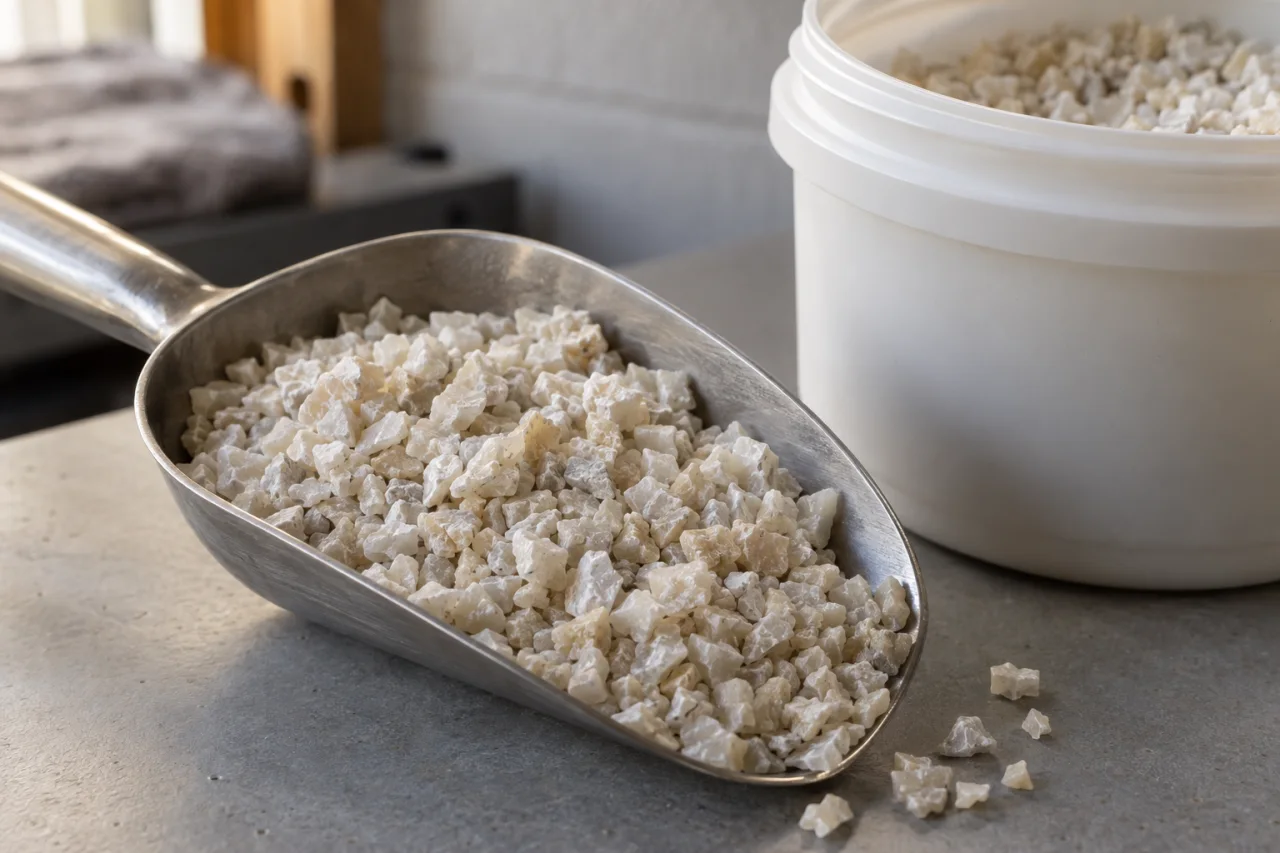
Verify exact-model claims before comparing promises
Certification is most useful when it answers a specific question. NSF/ANSI 42 addresses aesthetic claims such as chlorine taste and odor; 53 addresses health-effect contaminant reduction; 44 covers cation-exchange softeners; and 58 covers reverse osmosis systems. These numbers are not quality rankings. (nsf.org)
Request the exact model's certification listing and performance data sheet. Match the named contaminant, rated flow, capacity and replacement components to the proposal. A certified component is not automatically proof of every claim made for a complete assembled system. (nsf.org)
Do not assume nuisance-odor treatment or media-bed cleaning establishes drinking-water disinfection. Penn State specifically cautions that bacterial contamination requires disinfection rather than reliance on carbon filtration. (extension.psu.edu)
Compare the full ownership plan before choosing
Compare ownership obligations alongside the installed price. Cartridge disposal, spent media, salt, neutralizer replenishment, backwash water and RO reject water are different burdens. Request a written schedule of likely consumables and service tasks without treating an estimated replacement interval as a guarantee. (extension.psu.edu)
Read the proposed product's warranty separately from any installer agreement. For example, the Water-Right ONE Filtration warranty excludes removal and installation labor and identifies unapproved replacement cartridges, filters or parts among its exclusions. Those terms illustrate why compatibility and labor coverage deserve direct questions; they are not universal terms for every product. (aosmith.com)
The Water Knight offers Water Filtration, softening and drinking-water treatment for Moore County homes and businesses. Bring your results and priorities to a discussion about the appropriate assessment and proposed work. Water treatment visits are by arrangement.
- What equipment, bypasses, drains, electrical work and startup tasks are included?
- Which consumables are required, and what conditions determine replacement?
- Are replacement media and cartridges manufacturer-approved for this exact system?
- What water chemistry, pressure, temperature or maintenance conditions exclude warranty coverage?
- Who pays for diagnosis, travel, shipping, removal, installation and labor?
- What follow-up testing will show whether the treatment target is being met?
Questions & answers
Can one treatment material solve every water problem?
No. Sediment, hardness, acidity and dissolved contaminants call for different treatment mechanisms. A combination may be appropriate, but each stage should have a defined purpose supported by water results. More stages are not automatically better. (extension.uga.edu)
Is catalytic carbon always better than activated carbon?
Not for every application. Catalytic carbon can be useful for chloramine reduction and certain sulfur-treatment applications. Compare the actual system's claim, rated flow and operating conditions rather than treating the word catalytic as a universal upgrade. (calgoncarbon.com)
Does NSF/ANSI 58 mean an RO system removes every dissolved contaminant?
No. Verify the exact system and its listed reduction claims. A standard number identifies a testing framework, not blanket removal of every substance that might appear in your water. (nsf.org)
Will a manufacturer warranty pay for a service visit?
Do not assume so. The Water-Right ONE Filtration limited warranty, for example, excludes removal and installation labor. Ask for the proposed model's warranty and a separate written explanation of any installer labor coverage. (aosmith.com)
Sources & further reading
- Penn State Extension: Tips for Buying Water Treatment Equipment
Treatment selection based on testing, carbon applications and limitations, specialty ion exchange, maintenance and purchasing considerations.
- University of Georgia Cooperative Extension: Water Quality and Common Treatments for Private Drinking Water Systems
Different treatment mechanisms, point-of-use versus point-of-entry decisions, resin regeneration, neutralizing-media replenishment and equipment planning.
- University of Georgia Cooperative Extension: Mechanical Filtration Methods and Devices
Sediment cartridge operation, particle ratings, loading, pressure loss and mechanical-filter selection.
- Calgon Carbon Corporation: CENTAUR
Manufacturer-described catalytic-carbon applications for chloramine and hydrogen sulfide; not evidence of certification for a proposed complete system.
- Penn State Extension: Iron and Manganese in Private Water Systems
Iron and manganese treatment chemistry, oxidation followed by filtration, backwashing and maintenance requirements.
- NSF: Standards for Water Treatment Systems
Scope of NSF/ANSI 42, 53, 44 and 58 and the distinction between standard numbers and performance rankings.
- U.S. EPA: Point-of-Use Reverse Osmosis Systems
RO treated and reject streams, water-efficiency considerations and WaterSense performance evaluation.
- Water-Right ONE Cartridge Tank Filters: Installation Instructions and Owner's Manual
Product-specific example of approved replacement requirements, application limits and exclusion of removal and installation labor from manufacturer warranty coverage.
- https://extension.uga.edu/publications/detail.html?number=B939&title=water-quality-and-common-treatments-for-private-drinking-water-systems
Guidance referenced in this article on Carbon, Resin, Membranes and Mineral Media: A Water Treatment Options Guide.
- https://extension.uga.edu/publications/detail.html?number=B1523
Guidance referenced in this article on Carbon, Resin, Membranes and Mineral Media: A Water Treatment Options Guide.
Prepared and automatically checked on . Conditions, costs and requirements can change. Ask about the details that apply to your situation.
Continue reading
Helpful next reads
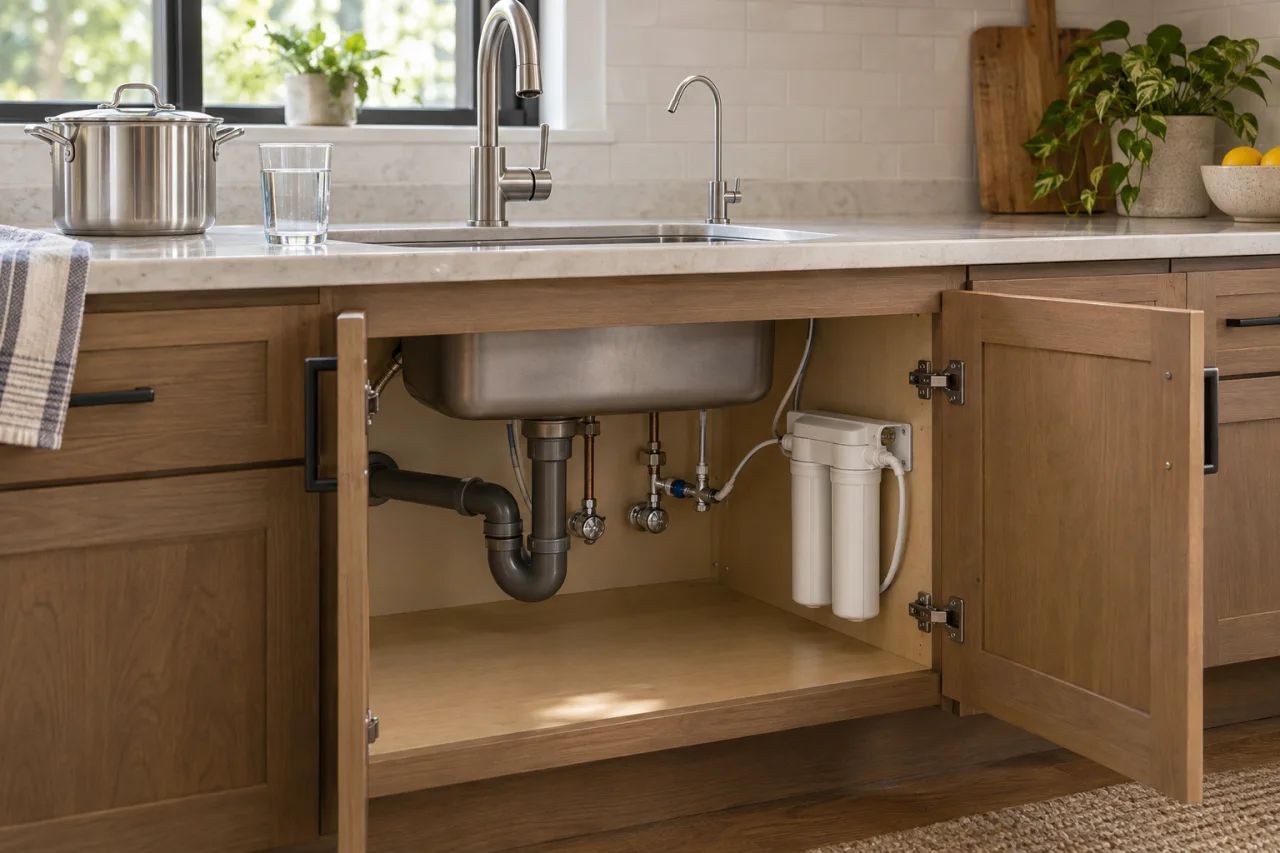
Whole-House or Under-Sink Filtration: Where Should Treatment Happen?
Whole-house treatment is not automatically the better choice. Compare where water is used, what needs reducing and how much maintenance each option requires.
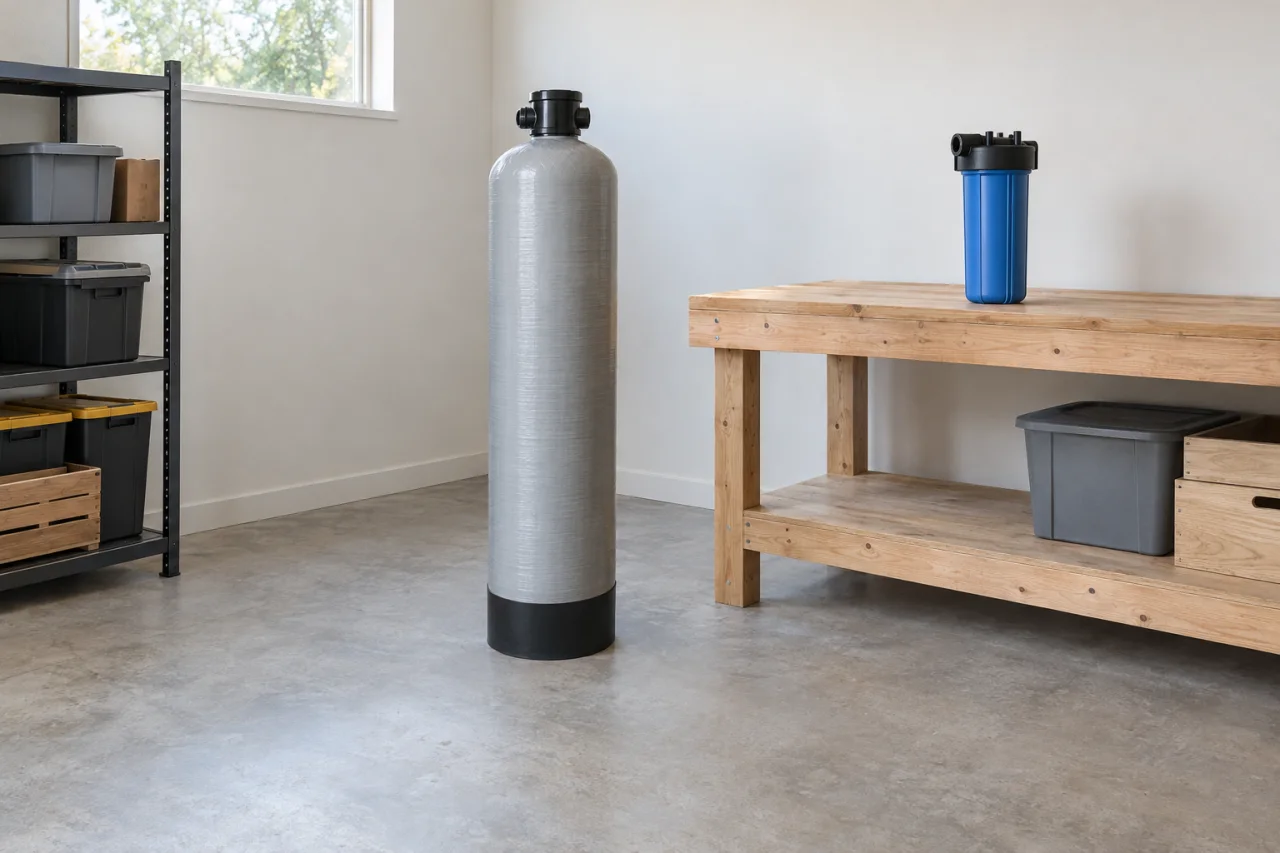
What Drives the Cost of Whole-House Water Filtration?
Two whole-house filtration proposals may solve different problems. Compare water results, treatment flow, installation requirements and replacement expenses before choosing.

PFAS and Your Drinking Water: What to Check Before Choosing a Filter
PFAS concerns call for specific evidence, not a bigger filter by default. Find relevant results, understand their limits and verify the exact treatment claim before buying.