
Practical guides · questions
PFAS and Your Drinking Water: What to Check Before Choosing a Filter
PFAS concerns call for specific evidence, not a bigger filter by default. Find relevant results, understand their limits and verify the exact treatment claim before buying.

What you’ll learn
- Begin with recent results for your actual public water system or private well; nearby detections do not establish conditions at your property.
- Keep measured concentrations, public-system regulations and product reduction claims separate.
- Verify the exact model and PFAS claim in the certifier’s current directory, including the specified replacement components.
- Compare maintenance, service access and ongoing costs before committing to equipment.
Concern about PFAS does not establish that these chemicals are present in your home’s drinking water—or that a particular filter is needed. A measured approach starts with relevant results, then checks what those results mean and which treatment claims actually match them. For households in West End and Moore County, the goal is a clear decision: whether further testing, a conversation with your provider or a carefully specified drinking-water system is the appropriate next step.
1. Find results for the water you actually receive
For a public water supply, identify the provider and system name on your bill—not just your town or mailing address. Request its latest PFAS results, sample dates and any explanation of treatment changes since sampling. Ask whether the numbers describe untreated source water or finished drinking water.
North Carolina’s public-system sampling page is a useful starting point, but it does not include every provider’s voluntary monitoring. A missing map entry is not proof that a supply has no PFAS. Likewise, an older detection elsewhere in the county does not establish conditions at your property.
Keep the annual Consumer Confidence Report alongside newer PFAS results and notices. How to Read Your Moore County Water Quality Report explains how to approach that broader document. For this decision, the most useful information is the latest applicable result and the provider’s explanation of what it represents.
2. Make the testing scope explicit
If you use a private well—or need property-specific information—ask explicitly about PFAS laboratory testing. Do not assume a general water assessment includes it.
EPA Methods 533 and 537.1 are established drinking-water methods; together they cover 29 PFAS. A panel does not measure every chemical in the PFAS family. The method, compound list and reporting limits should match the question you are trying to answer.
Contact the state laboratory certification program for laboratory recommendations. When discussing Water Testing with The Water Knight, clarify the proposed scope before proceeding, including whether specialized laboratory analysis must be arranged separately. A general service description does not establish that a particular PFAS panel is included.
- Ask whether PFAS analysis is included in the proposed laboratory panel.
- Confirm the drinking-water method and the individual compounds reported.
- Request reporting limits before ordering the analysis.
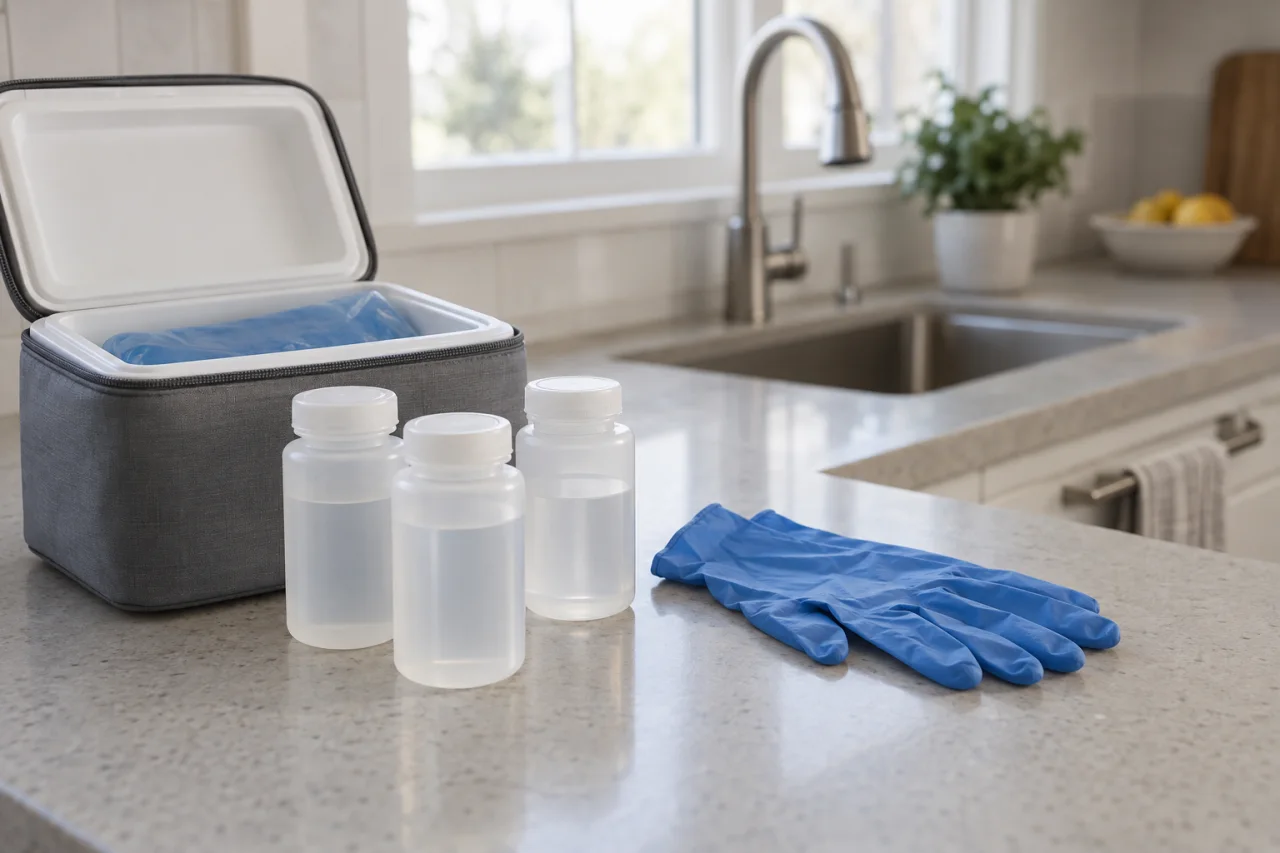
- Obtain the laboratory’s collection, storage and shipping instructions before taking a sample.
3. Separate the measured result from the regulatory question
A laboratory concentration describes a particular compound in a particular sample. Record its name, value, unit and sample date. Parts per trillion may also be expressed as nanograms per liter, or ng/L.
“Not detected” is not the same as proven zero. Detection and reporting thresholds differ, and laboratories may detect a substance at a level they cannot reliably quantify. Ask the laboratory to explain qualifiers rather than interpreting an abbreviation by itself. An older non-detect result with a higher reporting threshold may not answer the same question as newer testing.
Keep measurements separate from legal requirements. As checked November 6, 2026, EPA’s rule page lists the 2024 PFOA and PFOS limits at 4.0 parts per trillion each. It also describes May 18, 2026 proposals affecting compliance timing and other PFAS provisions. Those proposals should not be presented as finalized changes. Public-system compliance also involves running annual averages, not simply one isolated result.
4. Verify the exact model—not just the technology
A standard number is only the beginning. Look for certification to NSF/ANSI 53 or NSF/ANSI 58 with an explicit PFAS reduction claim. A logo, a claim about chlorine taste or a statement that a product was “tested” is not enough to establish that claim.
Use the certification body’s current directory to search the manufacturer and exact model. NSF’s directory offers separate searches for PFOA, PFOS and Total PFAS reduction. Read the actual listing; do not interpret “Total PFAS” as every chemical in this large family.
Match the proposed system and replacement cartridge to the listing and performance information. Ask which compounds the claim covers, its tested conditions and its rated treatment capacity. If a seller cannot provide that information, pause the comparison.
Do not equate a reduction claim with a promise to reach a particular concentration at your tap. EPA’s filter guidance includes a caution dated April 2024 about certification thresholds versus drinking-water limits. For a purchase now, request current documentation rather than treating that historical caution—or a marketing percentage—as the complete answer.
Three different kinds of evidence—and what each can establish
| Evidence | What it helps answer | Important limitation |
|---|---|---|
| Laboratory result | Which listed compounds were measured in the sample | It does not measure every PFAS or describe every future sample. |
| Public drinking-water regulation | Applicable limits, monitoring and compliance requirements | It is not a household filter performance certification. |
| Exact-model certification | Specific independently verified product reduction claims | It does not establish which contaminants are present at your property. |
5. Compare options around the water you intend to treat
Carbon, specialized ion-exchange media and reverse osmosis can reduce PFAS, but the technology name alone cannot identify the right product. Compare certified claims against the compounds in your results.
For Drinking Water Systems, decide which outlets need treatment: a kitchen faucet, refrigerator supply or another drinking-water location. A point-of-use device treats water at that location, not every tap. Whole-House or Under-Sink Filtration explores that placement decision in more detail.
Ask practical questions alongside performance questions. Can the system supply the drinking and cooking water you use? Is there accessible space for service? For RO, account for the reject-water stream and any incoming-water treatment requirements. For carbon or resin, recognize that treatment capacity is limited and replacement remains necessary. No format deserves a blanket recommendation without the exact claim and installation requirements.
6. Plan maintenance and verification before installation
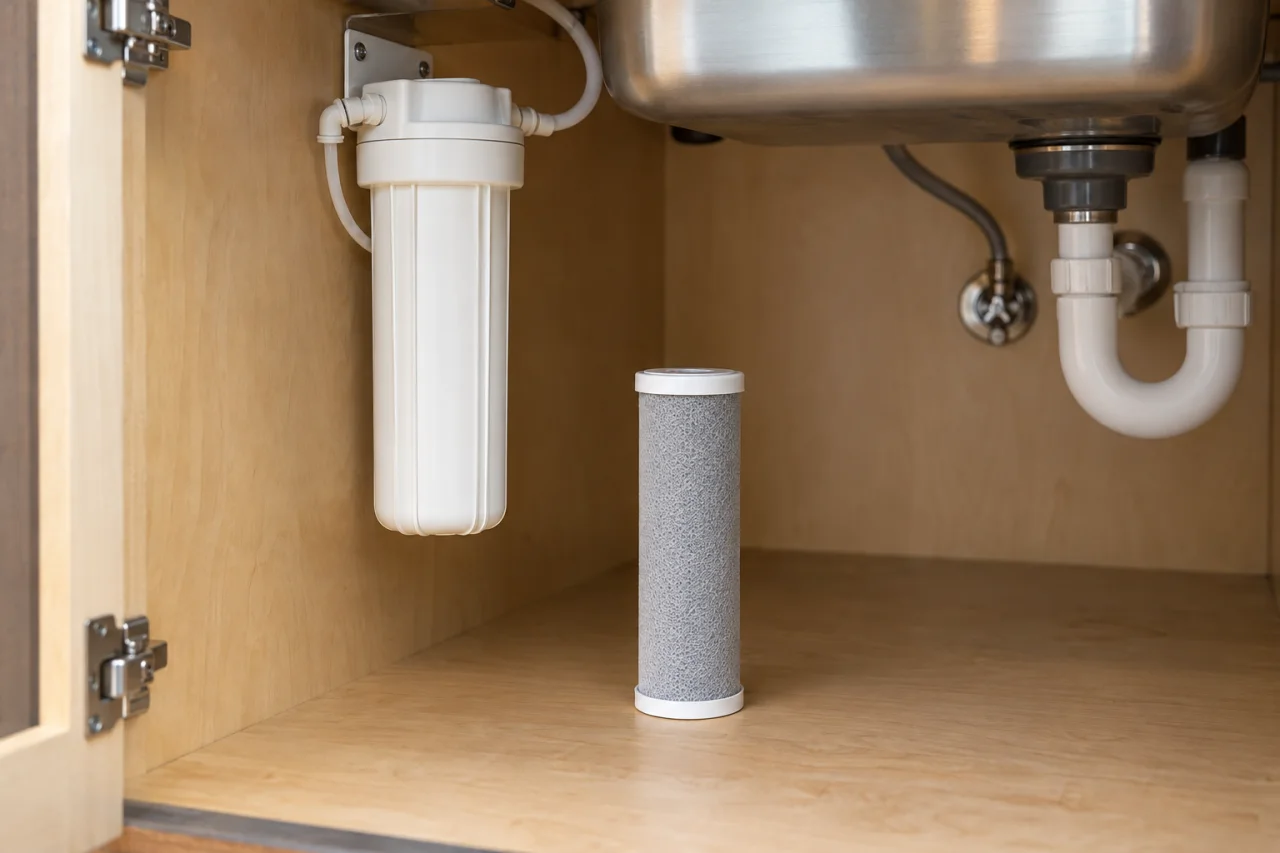
Maintenance is part of the treatment decision, not an optional extra. Filters must be maintained according to the manufacturer’s instructions. Do not substitute a different cartridge simply because it fits the housing.
Before purchase, make sure replacement parts are obtainable and the service space is usable. Ask who will track changes and what happens if consumption increases. A calendar reminder can help with scheduling, but it cannot establish the concentration leaving the filter.
Where results warrant treatment, discuss a follow-up sampling plan with the laboratory or relevant environmental agency. Define the question first: confirming initial reduction and evaluating performance later in service are different objectives. Do not assume that an initial result proves indefinite performance.
- Record the exact approved replacement cartridge or membrane.
- Identify both the replacement schedule and any rated-capacity limit.
- Keep installation and replacement dates with the product information.
- Ask what a system indicator measures and whether it measures PFAS at all.
- Discuss whether follow-up laboratory sampling would help evaluate the chosen treatment.
7. Ask for a complete, comparable proposal
Compare proposals using the same written scope. Ask whether each includes the treatment equipment, required plumbing changes, any pretreatment, installation supplies and the specified replacement components. Identify laboratory analysis separately so an equipment quote is not mistaken for a testing-and-treatment package.
For ongoing expenses, request current cartridge and membrane costs, expected replacement requirements under the manufacturer’s instructions, service charges and RO water-use information where applicable. Avoid comparing only the initial equipment price.
Ask the seller to connect each proposed item to a documented need or installation requirement. A larger system or more treatment stages is not, by itself, evidence of a better match.
8. Choose the next step from the evidence
Bring together your provider’s latest results or complete laboratory report, the proposed model’s current certification listing and its maintenance requirements. If one is missing, resolve that gap before making a PFAS-specific purchase.
For a private well with concerning results, contact the state environmental or health agency for advice about exposure reduction and whether an alternate water source is appropriate while treatment is evaluated. A result does not predict an individual health outcome; personal medical questions belong with your clinician.
The Water Knight serves West End and Moore County with water testing and treatment services. Water treatment visits are by arrangement. Bring your available results and questions to the discussion, and ask what assessment is appropriate before choosing equipment.
Questions & answers
Does a PFAS detection mean my public water system is violating a drinking-water rule?
Not necessarily. A detection is a measurement; a regulatory violation depends on the applicable rule, compliance dates and required calculations. Under the 2024 federal PFAS rule, compliance is determined using running annual averages at the sampling point. Ask your provider to explain the result and any current notices.
Does “not detected” mean there is absolutely no PFAS?
No. It means the laboratory did not report a detection under the method and reporting conventions used. Ask for the reporting limit for each compound. Results from different laboratories or years may not be directly comparable when their reporting thresholds differ.
Can a pitcher or refrigerator filter reduce PFAS?
Some models can. The format alone does not establish performance. Verify the exact model, replacement cartridge and PFAS reduction claim in the certifier’s directory. A taste-and-odor claim is not a substitute for a PFAS claim.
Does NSF/ANSI 58 certification automatically mean an RO system reduces PFAS?
No. Look for the specific PFAS reduction designation as well as the standard number. Certification claims vary by product, so check the current listing rather than relying on a general statement about reverse osmosis.
What should I do if my private well has a concerning PFAS result?
Contact your state environmental or health agency for result-specific advice, including whether an alternate drinking-water source is appropriate while treatment is evaluated. Keep the full laboratory report. If you have personal health concerns, discuss them with your clinician rather than relying on a filter seller to interpret medical risk.
Sources & further reading
- NC DEQ: PFAS Sampling of Public Water Systems
North Carolina public-system PFAS sampling coverage, limitations of the state map and the recommendation to contact the specific provider for additional results. ([deq.nc.gov](https://www.deq.nc.gov/news/key-issues/emerging-compounds/understanding-pfas/deq-pfas-sampling-public-water-systems))
- EPA PFAS Drinking Water Laboratory Methods
EPA drinking-water methods 533 and 537.1, their combined analyte coverage, laboratory certification contacts and limitations of alternative or modified methods. ([epa.gov](https://www.epa.gov/pfas/epa-pfas-drinking-water-laboratory-methods))
- EPA: Per- and Polyfluoroalkyl Substances—Drinking Water Regulation
The 2024 PFOA and PFOS limits, ng/L equivalence, running-annual-average compliance and the May 18, 2026 proposals distinguished from the final 2024 regulation. ([epa.gov](https://www.epa.gov/sdwa/and-polyfluoroalkyl-substances-pfas))
- EPA: PFAS Occurrence and Contaminant Background Support Document, April 2024
Section 2.4.1 explains detection versus quantitation/reporting thresholds and why differing reporting thresholds affect comparisons between datasets. ([epa.gov](https://www.epa.gov/system/files/documents/2024-04/updated-technical-support-document-on-pfas-occurrence_final508.pdf?utm_source=openai))
- EPA: Identifying Drinking Water Filters Certified to Reduce PFAS
Point-of-use treatment, carbon, ion exchange and RO mechanisms; finite filter capacity; RO reject water and pretreatment considerations; specific PFAS certification claims; and the explicitly dated April 2024 certification-threshold caution. ([epa.gov](https://www.epa.gov/water-research/identifying-drinking-water-filters-certified-reduce-pfas))
- NSF: Water Filters FAQs
Verification through the certification body’s current directory, product-specific contaminant claims, NSF/ANSI 53 or 58 with a PFAS designation and manufacturer-directed replacement requirements. ([nsf.org](https://www.nsf.org/about-nsf/faqs/water-filters-faqs))
- NSF: Certified Drinking Water Treatment Units Directory
Directory searches by manufacturer, brand/model, standard and reduction claim, including separate PFOA, PFOS and Total PFAS search options. ([info.nsf.org](https://info.nsf.org/Certified/DWTU/))
- EPA: PFAS in Private Wells
Private-well advice to contact environmental or health agencies, consider certified treatment or alternate drinking-water sources, continue testing and consult a physician about personal health concerns; maintenance as a condition of filter effectiveness. ([epa.gov](https://www.epa.gov/cleanups/pfas-private-wells))
Prepared and automatically checked on . Conditions, costs and requirements can change. Ask about the details that apply to your situation.
Continue reading
Helpful next reads
Private Well Testing in Moore County: What to Test and When
Start with annual indicators, then build in broader North Carolina testing reminders and additional tests based on your well's history, surroundings and changes.
From Water Sample to Treatment Plan: Understanding the Testing Steps
A useful water test starts before the bottle is filled. Learn how panel selection, sampling conditions and laboratory reporting shape a practical treatment decision.
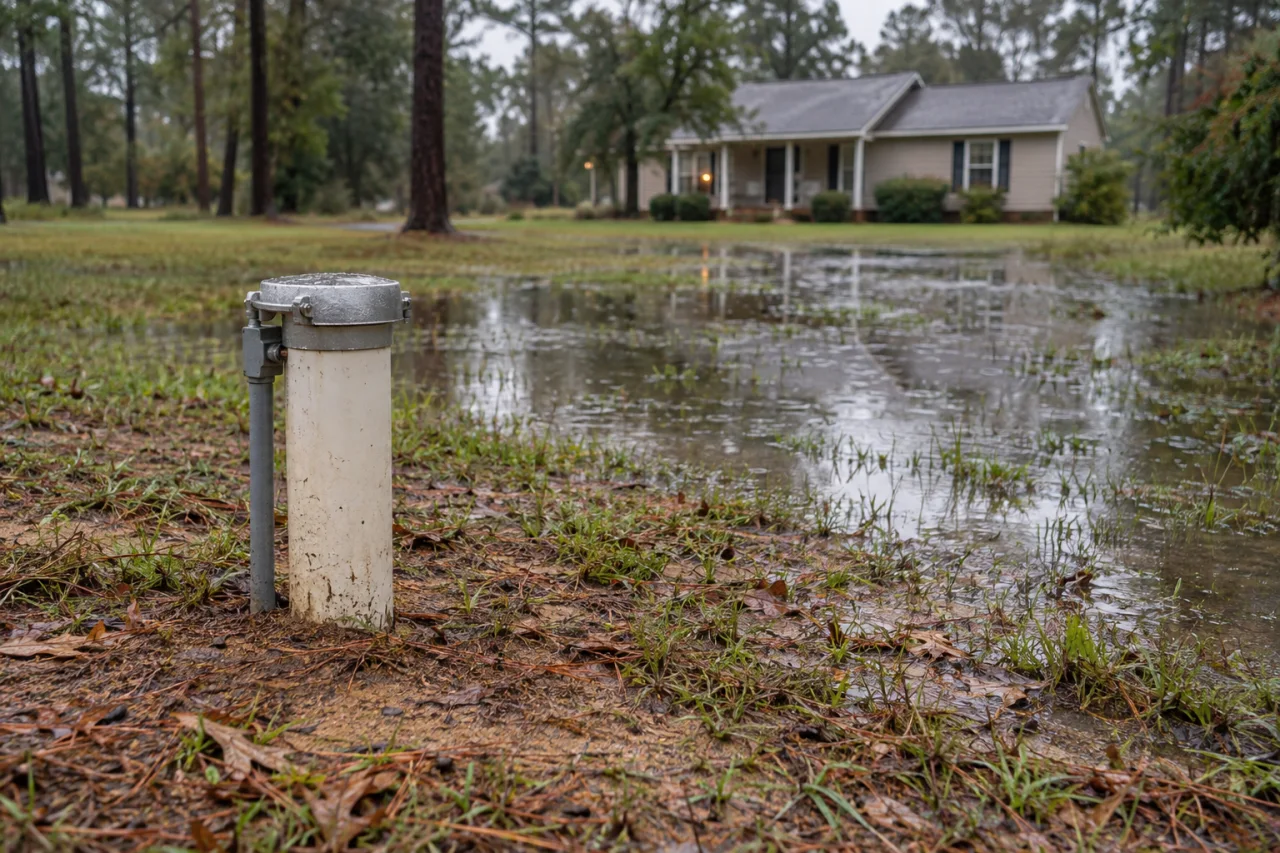
What Should You Do With Well Water After Flooding or a Power Outage?
A working pump does not establish water safety. Separate power loss from flood exposure, choose temporary water carefully, and use appropriate assessment and testing before resuming use.