Practical guides · local
How to Read Your Moore County Water Quality Report
Your utility report is a useful starting point—not a test of every faucet. Learn how to find the right Moore County report, interpret its numbers and decide what needs a closer look.

What you’ll learn
- Match your bill's supplier and public water system number to the report; a mailing address alone is not enough.
- Keep the reporting year, sample dates and source-water assessment date separate.
- Read units, statistical summaries and violation explanations together before drawing conclusions.
- A utility report does not establish water quality at every household faucet.
- Use a defined concern to guide tap testing, treatment claims and maintenance decisions.
Your annual water quality report can explain where your drinking water comes from, what monitoring found and whether your system met applicable requirements. It cannot answer every question about the water leaving your kitchen faucet. For Moore County households, the most useful first step is simple: identify the supplier on your water bill before choosing a report. Then separate the report's dates, units and compliance findings from questions that may need property-specific testing.
1. Match the report to your supplier
Your mailing address is a starting point, not proof of your water supplier. Before searching for a town's report, check your bill for the utility name, report link or public water system number. If the bill is unclear, ask the utility to identify the system serving your address.
This matters because a report can contain results from both a purchasing utility and the utility supplying its treated water. Those tables describe different parts of the supply arrangement; they are not interchangeable.
If your property uses a private well, a nearby utility's report does not describe your well. Use the private well testing guide instead. A shared community system is different from an individual household well, so confirm the arrangement rather than assuming.
- Find the drinking-water supplier on your bill, not just the payment processor.
- Confirm the public water system name and identification number.
- Ask the supplier which report applies to your service address.
- If water is included in rent, request the report from the landlord or property manager.
2. Separate the report year from the sample dates
A Consumer Confidence Report, or CCR, summarizes a reporting period. It is not a live reading of today's water. North Carolina's instructions required the 2025 report by July 1, 2026. Read the year inside the document rather than relying on a search-result date or filename.
Keep three dates separate: the reporting year, each contaminant's sample date, and any source-water assessment date. Some sampling is permitted less frequently than annually, so an older result is not automatically a missed test.
A verified local example is the MCPU-Addor 2025 Drinking Water Quality Report, system 03-63-153. It includes Addor lead and copper samples from June–July 2024. Its source-water assessment is dated September 10, 2020. These dates answer different questions; none should be mistaken for a test performed at your home today.
3. Read the units before judging the number
Read one contaminant row all the way across before comparing numbers. Identify the substance, unit, sample date, reported level, range and applicable standard.
For these water reports, ppm corresponds to milligrams per liter, ppb to micrograms per liter, and ppt to nanograms per liter. One ppm equals 1,000 ppb. A larger-looking number is not necessarily a higher concentration when the units differ.
The limit and the goal also serve different purposes. An MCL is an enforceable maximum contaminant level; an MCLG is a health-based goal, not the compliance limit. Disinfectants have their own maximum residual disinfectant levels. An action level triggers specified requirements and should not be treated as an ordinary MCL.
Use the report's definitions rather than assuming every row follows the same rule.
Report terms that change how a result should be interpreted
| Term | Meaning | Important limitation |
|---|---|---|
| MCL | Highest contaminant level allowed in drinking water | Compare using the same units and the applicable compliance calculation. |
| MCLG | Health-based goal below which no known or expected health risk exists | A goal is not the same as an enforceable limit. |
| AL | Action level that triggers treatment or other requirements when exceeded | Read the sampling summary and explanation, not just one number. |
| ND or N/D | Not detected at the method's detection level | Does not establish an exact concentration of zero. |

4. Find out what the reported level represents
A column labeled Your Water is not necessarily a measurement from your faucet—or even the highest individual sample. Depending on the contaminant and monitoring schedule, it may represent a maximum, an average or a statistical summary. Check headings and footnotes.
RAA means running annual average. LRAA means locational running annual average, calculated for a particular sampling location across four calendar quarters. A range shows low and high individual results and may differ from the number used to determine compliance.
For lead and copper, reports use a 90th-percentile result and list how many sampling sites exceeded the action level. That summary cannot guarantee every sampled property had the same result, much less describe an unsampled home. When a number seems inconsistent with the violation column, ask the utility which calculation applies.
5. Read violations in their time and system context
Detection alone does not mean a violation. Conversely, a report can describe a monitoring or reporting violation without documenting a contaminant above its limit. Read the explanation for the specific rule involved.
Look for what happened, the affected dates, potential health implications and corrective action. A violation described in an annual report may already have been resolved. Ask whether any advisory or restriction remains in effect before deciding what to do now.
The MCPU-Addor 2025 report states that the system had no violations during 2025 or compliance periods ending in 2025. That statement applies to that system and period—not all of Moore County or every household tap. The report also explains that Addor purchases treated surface water from Southern Pines, sourced from Drowning Creek, which is why both systems appear in its tables.
6. Recognize what the report leaves unanswered at your tap
A utility report provides valuable supply-system information, but it is not a property-specific plumbing assessment. Lead can enter water as plumbing materials corrode. Fixtures, solder, service-line materials and the time water spends in pipes can affect exposure.
Ask your supplier about its service-line inventory and what is known about the connection serving your property. Even a service line identified as non-lead does not establish that every interior component is lead-free.
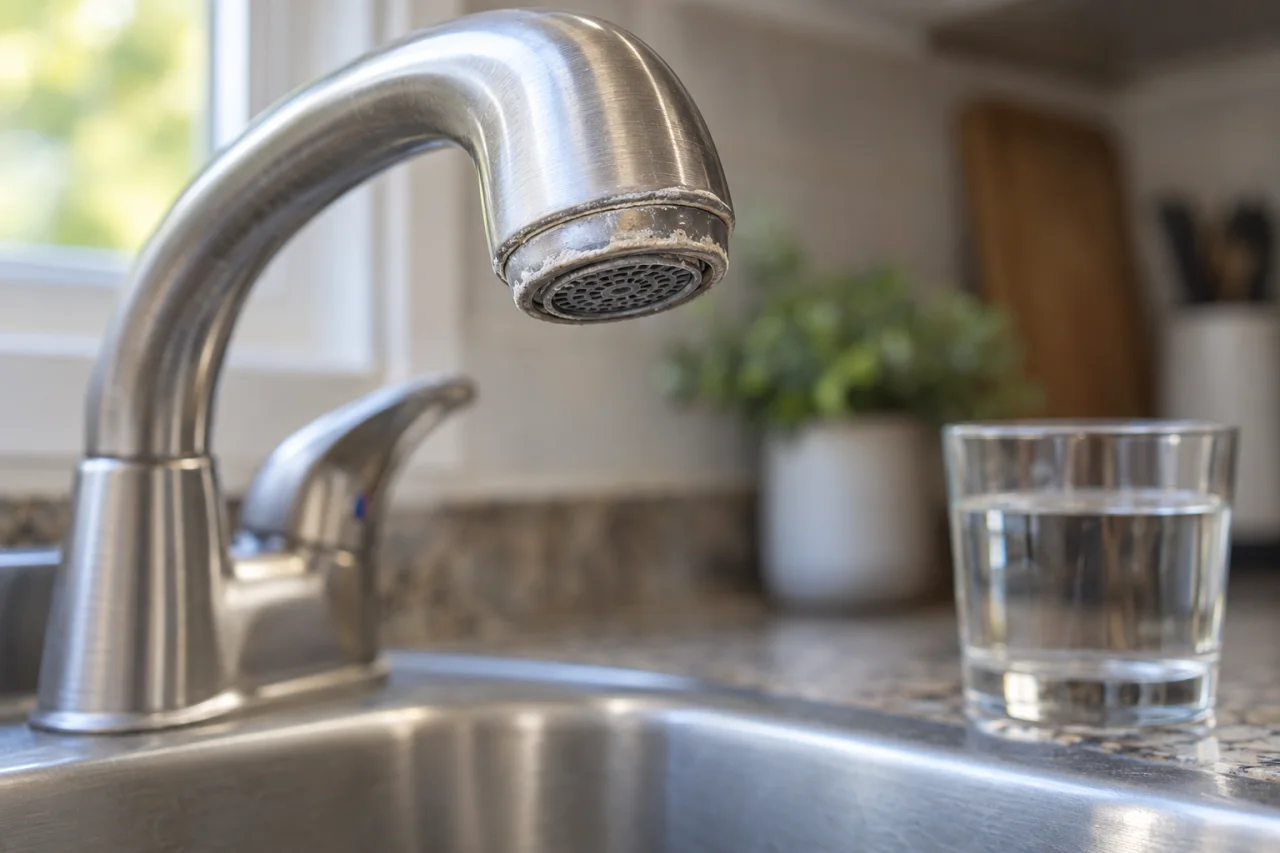
Appearance has limits, too. Clear water does not prove the absence of harmful contaminants, and an unpleasant taste does not by itself establish a health hazard. White deposits or recurring taste concerns deserve a separate question from regulatory compliance. The City Water service page discusses household treatment considerations, but equipment selection should follow an identified need rather than a frightening interpretation of a report.
7. Make any tap testing answer a specific question
Start with a question, not the broadest-sounding test package. A concern about lead at a drinking-water faucet calls for a different investigation from a taste complaint or a private-well bacteria concern.
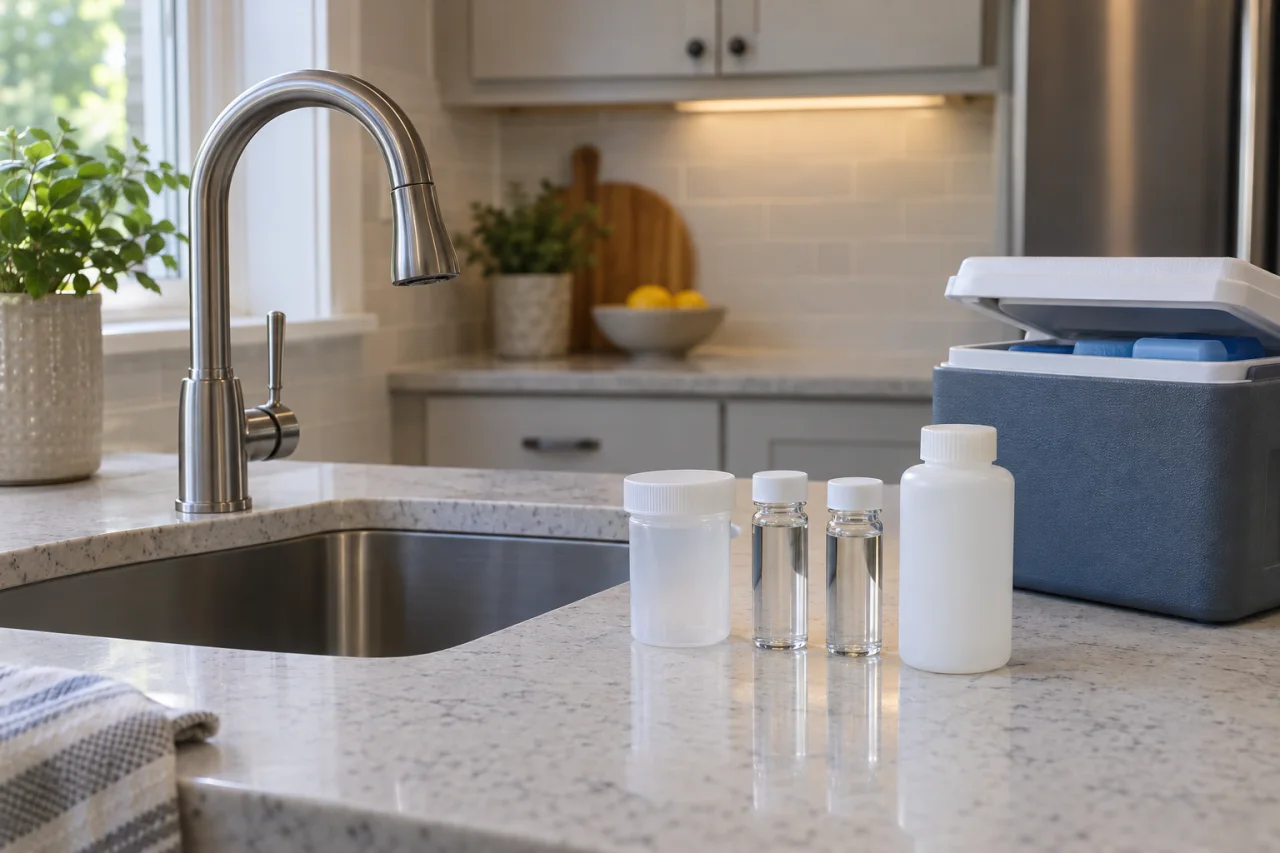
Contact the utility or health department for guidance on suitable testing and certified laboratories. Before collecting anything, obtain the required containers and sampling instructions. Do not assume that flushing, removing an aerator or sampling through an existing filter is appropriate for every analysis.
For a discussion about Water Testing with The Water Knight, bring the correct report and describe what you have noticed, where it occurs and whether treatment is already installed. Those details help define the assessment to arrange; they do not establish a diagnosis.
- What specific question will this test answer?
- Which contaminants are included, and which are excluded?
- Is the laboratory certified for the analysis needed?
- Which faucet and sampling conditions are appropriate?
- Should existing treatment remain in service during sampling?
- How will the result guide the next decision?
8. Choose treatment only after defining the goal
A report is a reason to investigate thoughtfully, not an automatic shopping list. If the concern is a particular contaminant, verify that the proposed equipment has a certification covering that specific reduction claim. A filter intended to improve taste is not automatically suitable for lead, PFAS or germs.
Then consider where treatment belongs. Comparing whole-house or under-sink filtration means deciding whether the goal concerns drinking and cooking water at one tap or water throughout the building. Neither location is universally better.
Ask about replacement cartridges, rated capacity, operating conditions and ongoing maintenance before buying. Follow the manufacturer's replacement schedule; neglected equipment can lose effectiveness. Keep the report, any tap-test results and maintenance records together so future decisions start with evidence rather than memory.
Questions & answers
Does my Moore County mailing address tell me which report to read?
No. Start with the supplier named on your water bill and ask which public water system serves your street address. Match the system name and identification number to the report. Renters can ask their landlord or property manager.
Why does a 2025 report include samples from 2024?
Some contaminants may be monitored less frequently than annually under applicable rules. Read each row's sample date and the report's explanation. The MCPU-Addor 2025 report, for example, includes its lead and copper sampling from June–July 2024.
Does ND mean there is absolutely none of a contaminant?
No. ND or N/D means the laboratory did not detect it at the detection level for the method used. It is not a statement that the concentration is exactly zero.
Can I use a compliant report to rule out lead at my kitchen tap?
No. Lead can enter water through service lines, solder, faucets and other plumbing materials. System compliance results do not establish the concentration at every faucet. Ask your utility about service-line information and appropriate tap testing.
Should I buy a filter because a contaminant appears in the table?
Not automatically. Check its level, units, applicable standard and violation status first. If treatment is warranted, choose equipment certified for the specific reduction needed and account for cartridge replacement and maintenance.
Sources & further reading
- NC Department of Agriculture and Consumer Services: Solutions and Water Testing
Explains how to locate a North Carolina report using the water bill's report link or system ID; also clarifies that agricultural water analysis does not cover all drinking-water concerns. ([ncagr.gov](https://www.ncagr.gov/divisions/agronomic-services/solution-analysis))
- CDC: How to Read Drinking Water Quality Reports
Supports annual report contents, checking the water bill to identify the supplier, obtaining reports through landlords, distinguishing private wells, and reviewing violation duration, health implications and corrective action. ([cdc.gov](https://www.cdc.gov/drinking-water/about/how-to-read-drinking-water-quality-reports.html))
- Moore County: MCPU-Addor 2025 Drinking Water Quality Report
Provides the dated local example: MCPU-Addor's 2025 report, system 03-63-153; June–July 2024 lead and copper sampling; September 10, 2020 source assessment; purchased Southern Pines water from Drowning Creek; and the report's statement of no violations for its specified period. ([moorecountync.gov](https://www.moorecountync.gov/DocumentCenter/View/229/Addor-Report-PDF?bidId=))
- EPA: Understanding Your Water Quality Report
Defines MCL, MCLG, disinfectant limits, reported ranges and treatment techniques; explains the general purpose of a Consumer Confidence Report. ([epa.gov](https://www.epa.gov/sites/production/files/2018-02/documents/epa-ogwdw-ccr-infographic-v5_508.pdf))
- NC DEQ: 2025 Consumer Confidence Report Instructions
Establishes the July 1, 2026 deadline for 2025 reports; explains reporting older monitoring results, unit conversion, separate supplier data, lead and copper summaries, and how disinfection-byproduct reporting varies by monitoring schedule. ([deq.nc.gov](https://www.deq.nc.gov/2025-ccr-instructions-finalv2pdf/download?attachment=))
- NC DEQ: 2025 Annual Drinking Water Quality Report Template
Supplies definitions of non-detects, ppm, ppb, ppt, action level, RAA and LRAA, plus report-table structures and explanations of monitoring and reporting violations. ([deq.nc.gov](https://www.deq.nc.gov/2025-annual-drinking-water-quality-report-finalpdf/download?attachment=))
- EPA: Basic Information about Lead in Drinking Water
Explains lead sources in service lines and household plumbing, factors affecting corrosion and exposure, the limitations of appearance, and consultation with suppliers and certified laboratories about testing. ([epa.gov](https://www.epa.gov/ground-water-and-drinking-water/basic-information-about-lead-drinking-water))
- CDC: About Choosing Home Water Filters
Supports contaminant-specific filter selection, the limits of taste and appearance, certified-laboratory guidance, point-of-use versus whole-home applicability, and following manufacturer maintenance recommendations. ([cdc.gov](https://www.cdc.gov/drinking-water/prevention/about-choosing-home-water-filters.html))
Prepared and automatically checked on . Conditions, costs and requirements can change. Ask about the details that apply to your situation.
Continue reading
Helpful next reads
Private Well Testing in Moore County: What to Test and When
Start with annual indicators, then build in broader North Carolina testing reminders and additional tests based on your well's history, surroundings and changes.
From Water Sample to Treatment Plan: Understanding the Testing Steps
A useful water test starts before the bottle is filled. Learn how panel selection, sampling conditions and laboratory reporting shape a practical treatment decision.
What Should You Do With Well Water After Flooding or a Power Outage?
A working pump does not establish water safety. Separate power loss from flood exposure, choose temporary water carefully, and use appropriate assessment and testing before resuming use.