Practical guides · decision
Is UV Water Treatment Right for Your Well? Start With Water Quality and Flow
UV can be a useful disinfection step for well water, but its suitability depends on pretreatment, UV transmittance, peak flow and the exact equipment configuration.
What you’ll learn
- UV addresses microorganisms; it does not remove hardness, metals or dissolved chemicals.
- Turbidity, sleeve-fouling minerals and UV transmittance can determine whether pretreatment is needed.
- Match the exact model’s rated conditions and certification to peak household flow.
- Power-loss safeguards, maintenance and downstream plumbing care belong in the decision from the start.
UV can be a useful part of a well-water treatment plan, but it is not an all-purpose purifier. Its job is disinfection—not removing hardness, metals or dissolved chemicals. For homeowners in West End and Moore County, the decision starts with two questions: what is in the water, and how much water must the system treat at its busiest moment? Before comparing units, understand the conditions that let UV work and the responsibilities that come with it.
1. Decide whether disinfection is the missing treatment
UV makes sense when microbial disinfection is an identified need and the incoming water can meet the selected system’s operating requirements. It uses ultraviolet light to inactivate susceptible microorganisms as water passes through a chamber. It does not physically strain them out.
That is a different job from removing dissolved chemicals or minerals. UV will not soften hard water, remove dissolved iron or address contaminants such as nitrate, arsenic or PFAS. If those are present, they require separately selected treatment.
For example, a household concerned about bacteria and scale may need both disinfection and hardness treatment. A household concerned only about hardness should not expect UV to solve that problem. Start with the problem you need to address, rather than selecting equipment first.
2. Get a water-quality picture before choosing equipment
Start with Water Testing, not a visual judgment at the kitchen sink. Routine well testing should include total coliform bacteria, nitrate, total dissolved solids and pH at least annually. Ask a state-certified laboratory or local health department which additional tests fit your well and surroundings.
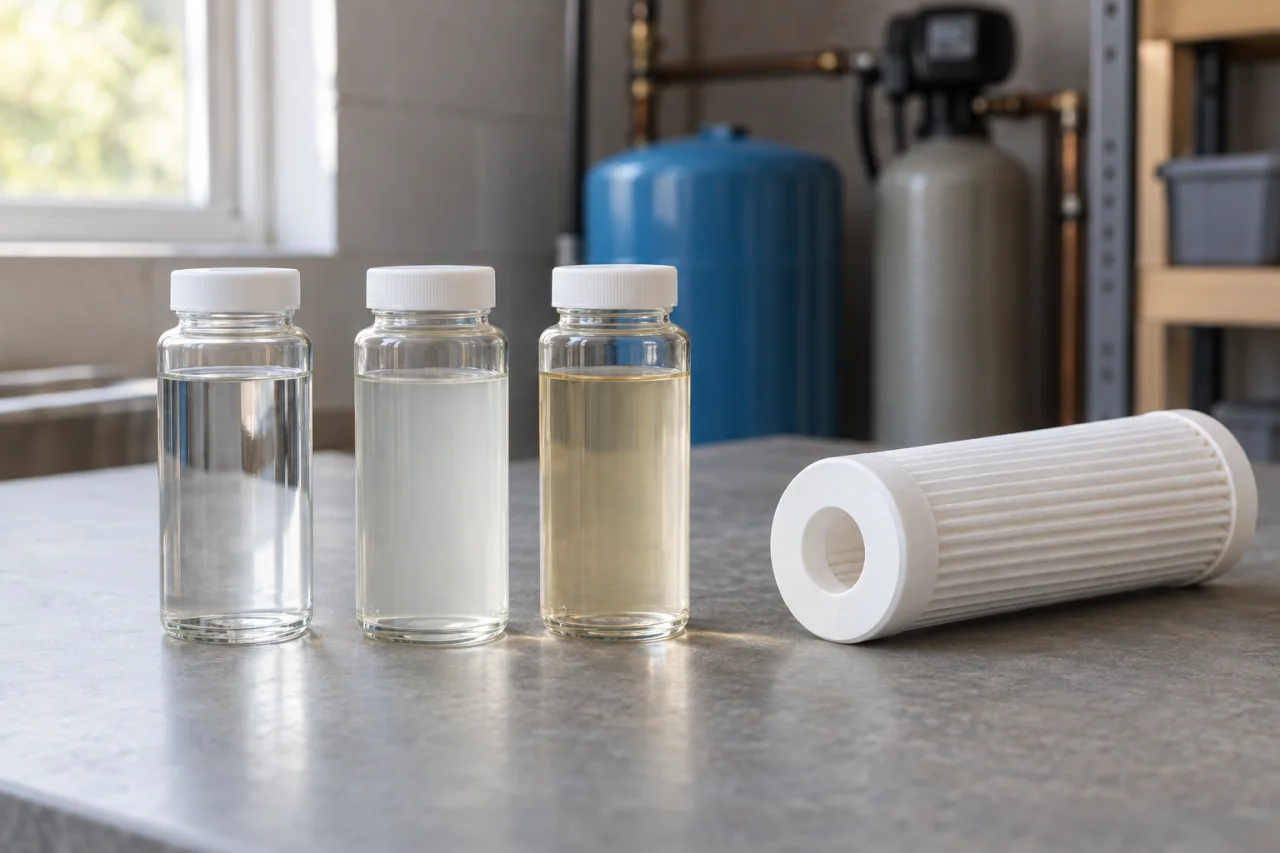
A UV assessment also needs information about turbidity, iron, manganese, hardness and potentially tannins or color. Ask whether UV transmittance testing is needed; it is not interchangeable with a routine bacteria test.
A positive bacteria result also deserves investigation of the water source and well condition. Do not treat equipment selection as the only response to possible contamination. Obtain guidance about safe water use while the problem is investigated. Our private well testing guide provides a broader starting point for deciding what to test and when.
3. Match pretreatment to what interferes with UV
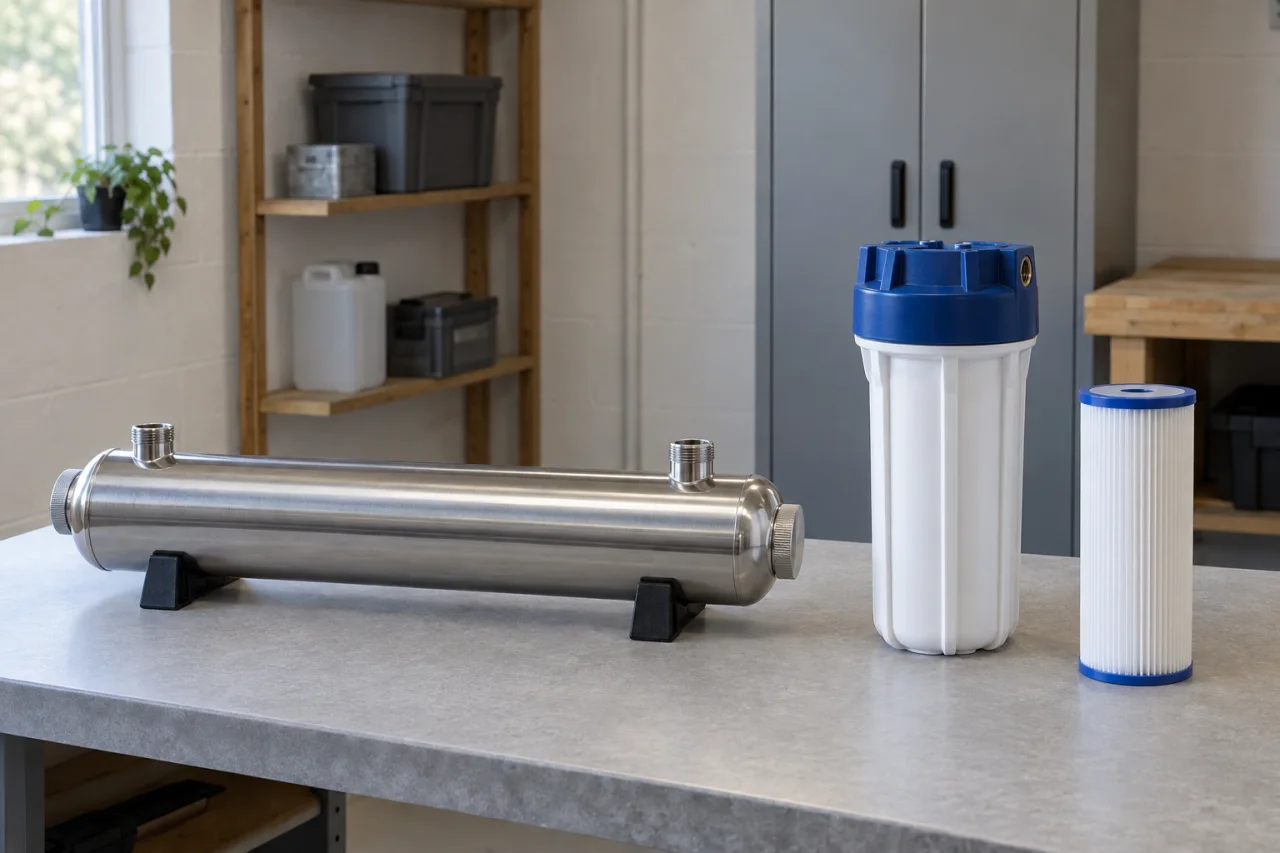
UV needs light to reach microorganisms. Suspended particles can shield them, while substances that absorb or scatter light can reduce treatment effectiveness. Iron and hardness can also leave deposits on the quartz sleeve surrounding the lamp.
The right pretreatment depends on the actual water. A sediment cartridge does not automatically solve dissolved iron, hardness or low UV transmittance. Water Filtration and softening serve different purposes, so ask what each proposed component addresses and what remains untreated.
Use the comparison below to guide that discussion. It is not a universal equipment specification: the exact UV model’s manual and treatment design determine acceptable conditions.
Conditions to address before water reaches a UV chamber
| Water condition | Why it matters | Decision and limitation |
|---|---|---|
| Turbidity and suspended sediment | Particles can shield microorganisms from UV light. | Select appropriate particle filtration; finer cartridges can restrict flow. |
| Iron and manganese | Deposits can foul the quartz sleeve and interfere with light transmission. | Determine whether dedicated removal is needed; sediment filtration alone may not address dissolved forms. |
| Hardness | Scale can coat the sleeve. | Compare hardness with model requirements; softening does not provide disinfection. |
| Color and low UV transmittance | Light-absorbing substances can reduce delivered UV exposure. | Measure UV transmittance where appropriate; clear-looking water is not proof of suitability. |
| Dissolved chemical contaminants | UV disinfection does not remove them. | Choose separate treatment with evidence for the specific contaminant. |
4. Read UV transmittance and peak flow together
UV transmittance, or UVT, describes how much ultraviolet light passes through the water. Lower UVT means less light penetrates it. A system’s advertised flow capacity therefore needs context: what UVT and dose were used to establish that rating?
Peak flow matters too. Sizing around average daily consumption can miss periods when showers, laundry and other fixtures operate together. Water moving beyond the unit’s approved capacity may not receive the intended exposure.
Ask for the proposed operating flow in gallons per minute, the applicable water-quality assumptions and whether a flow restrictor is required. Also discuss future fixtures and the effect of pretreatment on pressure. A larger number on a product brochure is not a substitute for matching capacity to the application.
5. Verify the exact model, not just the product family
Certification is specific to a model and its configuration, not simply its brand. NSF/ANSI 55 distinguishes Class A disinfection systems from Class B systems intended to reduce non-disease-causing bacteria in already disinfected drinking water. Class B should not be treated as interchangeable with Class A for a contaminated well.
The Water Knight’s supplied service information identifies VIQUA Home Series equipment. That does not establish that every available unit has identical certification, monitoring or flow capacity. Request the complete proposed model number and check its certification listing and manual.
Ask which sensors, restrictors or other components are necessary to maintain the certified configuration. Electrical safety approvals are also different from certification of water disinfection performance.
6. Plan for power loss and water already in the pipes
UV needs electricity. When the lamp is not operating, water passing through the chamber is not receiving UV disinfection. Do not assume that an alarm automatically stops the water: monitoring and shutoff features depend on the model and installed accessories.
Ask whether the proposed unit monitors lamp operation only or also measures UV intensity. Find out what happens during low UV output, lamp failure and loss of power. A compatible automatic shutoff can interrupt water service when disinfection cannot be assured, but its inclusion must be confirmed.
UV also leaves no continuing disinfectant residual in downstream pipes. Installation or an interruption may therefore require plumbing disinfection under the manufacturer’s instructions. Establish restart and warm-up requirements before an outage, rather than improvising afterward.
7. Include maintenance in the buying decision
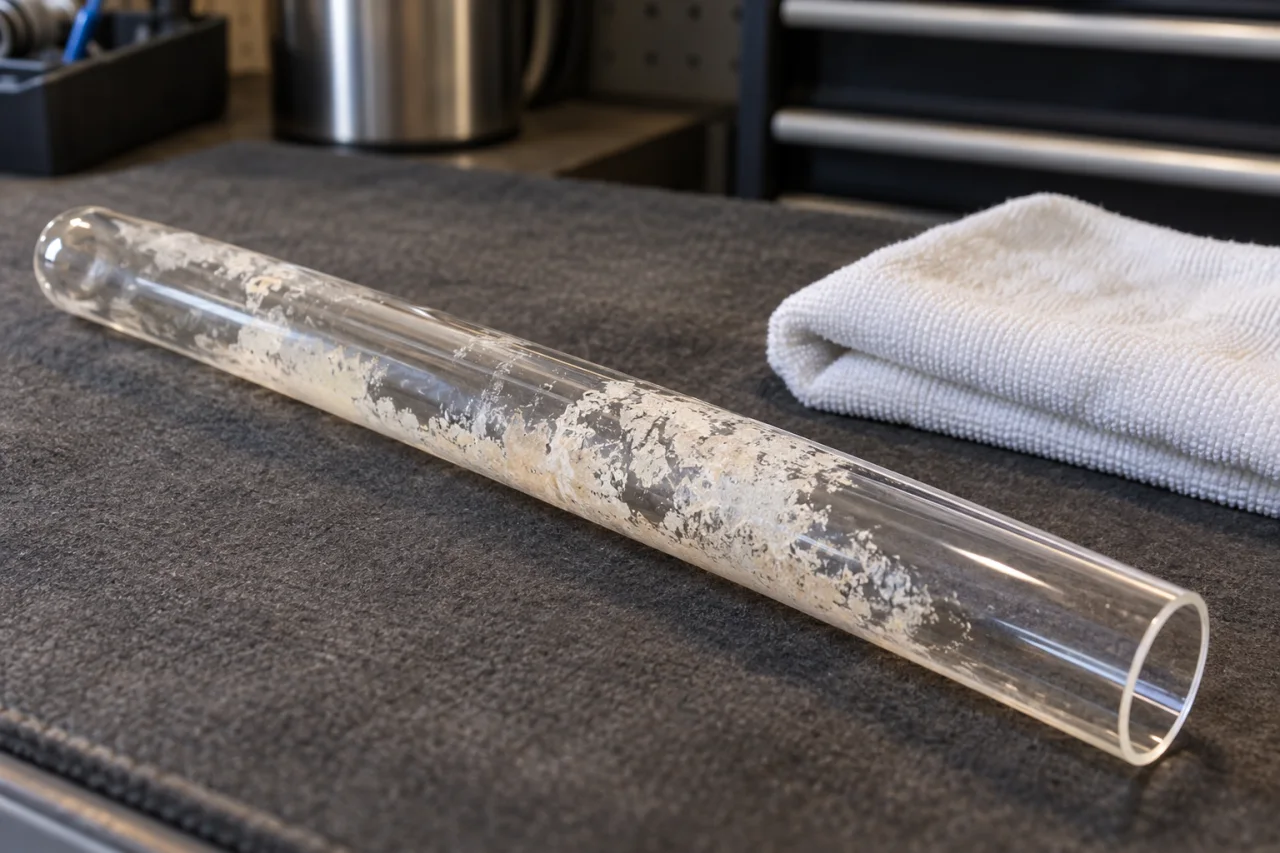
A UV system needs more than a working indicator light. Lamps require scheduled replacement, and mineral deposits must be removed from the quartz sleeve. Follow the exact model’s schedule rather than assuming one replacement interval applies across the entire range.
Pretreatment needs care as well. Neglected cartridges or exhausted treatment media can change the water reaching the UV chamber. Leave the required service clearance so lamps and sleeves can be removed without rebuilding the installation.
Before accepting a proposal, ask about replacement lamps, sleeve cleaning, filter cartridges, electricity and service access. These are ownership considerations, not just installation details. Our guide to UV system alarms and maintenance explains the follow-up questions worth keeping with your equipment records.
8. Ask for a complete treatment plan
A useful proposal connects the water results, pretreatment, rated flow and operating safeguards. It should make clear what UV addresses and what remains outside its scope.
For a home in West End or elsewhere in Moore County, bring recent laboratory results and details of existing treatment to the discussion. The Water Knight offers Water Testing, Water Filtration and UV Water Systems, with water treatment visits by arrangement. Ask to review those options against your well’s needs before deciding whether UV belongs in the plan.
- What testing establishes the disinfection need, and what source problems need attention?
- Will the treated water meet this model’s chemistry and UVT requirements?
- What peak flow can the complete system handle under those conditions?
- What exact certification, monitoring and automatic shutoff are included?
- What startup, outage recovery, maintenance and sampling instructions will be provided?
Questions & answers
Does clear well water mean UV will work properly?
No. Appearance does not establish microbiological safety or UV transmittance. Test the water and compare the results with the proposed model’s requirements, including the conditions used for its flow rating.
Will UV remove iron, hardness or PFAS?
No. Residential UV disinfection does not remove these dissolved substances. Any treatment for them needs its own suitability assessment and contaminant-specific performance evidence.
Do I still need well-water testing after installing UV?
Yes. UV does not replace routine well testing or checks for chemical contaminants. Keep an ongoing testing plan and ask how post-installation sampling will verify treatment performance.
Is every VIQUA Home Series system certified to the same standard?
Do not assume so. Verify the full model number, certification class, certified flow and required components. A brand name, product-family name or electrical safety mark does not establish identical disinfection capabilities.
Can I drink the water as soon as electricity returns?
Do not assume that restored power alone makes it ready. Follow the exact model’s warm-up and restart instructions, and obtain guidance about downstream disinfection and testing if untreated water may have entered the plumbing.
Sources & further reading
- CDC: About Home Water Treatment Systems
Supports the distinction between UV disinfection, chemical removal and softening; the value of prefiltration; and choosing treatment for identified contaminants. Supports sections 1 and 3 and the dissolved-contaminant FAQ. ([cdc.gov](https://www.cdc.gov/drinking-water/about/about-home-water-treatment-systems.html))
- CDC: Guidelines for Testing Well Water
Supports annual testing for total coliforms, nitrate, total dissolved solids and pH; use of state-certified laboratories; additional locally appropriate testing; and consultation about results. Supports section 2 and continued testing after UV installation. ([cdc.gov](https://www.cdc.gov/drinking-water/safety/guidelines-for-testing-well-water.html))
- VIQUA: UV Pretreatment
Supports interference from turbidity, suspended solids and color, plus iron, manganese and hardness deposits on sleeves. Supports the pretreatment discussion and comparison table. ([viqua.com](https://viqua.com/uv/pretreatment/))
- VIQUA: Frequently Asked Questions
Supports UVT-dependent flow ratings, sizing for maximum flow, potential flow restriction from finer prefilters, and distinctions between lamp monitoring and UV sensing. Supports section 4 and relevant table limitations. ([viqua.com](https://viqua.com/resources-24/faqs/))
- NSF: Standards for Water Treatment Systems
Supports the difference between NSF/ANSI 55 Class A disinfection and Class B reduction of non-disease-causing bacteria in disinfected water, and the importance of checking specific certification claims. Supports section 5. ([nsf.org](https://www.nsf.org/consumer-resources/articles/standards-water-treatment-systems))
- VIQUA Owner’s Manual: H, K, Plus and PRO Models
Supports model-specific water chemistry, startup after power interruptions, downstream plumbing disinfection, sleeve cleaning and scheduled lamp replacement. This manual covers H, K, Plus and PRO models; it is not evidence that every Home Series model has the same specifications. Supports sections 6 and 7 and the restart FAQ. ([viqua.com](https://viqua.com/wp-content/uploads/MNL602936_EN.pdf))
- VIQUA Owner’s Manual: D4 Premium, E4, F4 and Listed Variants
Supports configuration-specific UV sensing, optional solenoid shutoff equipment, certified-flow restriction, lamp replacement and maintenance access. This manual covers the listed D4, E4 and F4 variants rather than every VIQUA unit. Supports sections 5 through 7 and model-verification questions. ([viqua.com](https://viqua.com/wp-content/uploads/MNL520351-R_RevE-EN.pdf))
- CDC: How Water Treatment Works
Supports the explanation that UV does not continue killing microorganisms as treated water travels through downstream plumbing. Supports section 6. ([cdc.gov](https://www.cdc.gov/drinking-water/about/how-water-treatment-works.html))
Prepared and automatically checked on . Conditions, costs and requirements can change. Ask about the details that apply to your situation.
Continue reading
Helpful next reads
Private Well Testing in Moore County: What to Test and When
Start with annual indicators, then build in broader North Carolina testing reminders and additional tests based on your well's history, surroundings and changes.
From Water Sample to Treatment Plan: Understanding the Testing Steps
A useful water test starts before the bottle is filled. Learn how panel selection, sampling conditions and laboratory reporting shape a practical treatment decision.
What Should You Do With Well Water After Flooding or a Power Outage?
A working pump does not establish water safety. Separate power loss from flood exposure, choose temporary water carefully, and use appropriate assessment and testing before resuming use.