
Practical guides · maintenance
Reverse Osmosis Maintenance: Filter Changes, Slow Flow and Water Quality
Know which RO components need attention, what slow flow and alerts can mean, and why sanitation, restart procedures and water-quality checks must fit your exact system.
What you’ll learn
- Match replacement cartridges, intervals and service steps to the exact RO model.
- Slow flow can have several causes; it does not automatically mean the membrane has failed.
- Sanitation and extended-non-use procedures are equipment-specific.
- TDS trends and taste changes can prompt investigation, but neither establishes drinking-water safety.
An RO faucet that slows down, develops a different taste or displays an alert needs investigation—not an automatic membrane replacement. Keeping reverse osmosis equipment working properly means distinguishing routine cartridge care from a supply problem, an equipment fault or a water-quality concern. For homeowners in West End and Moore County, the most useful starting points are the exact model’s instructions, a maintenance record and a clear description of what changed.
Start with the system you actually own
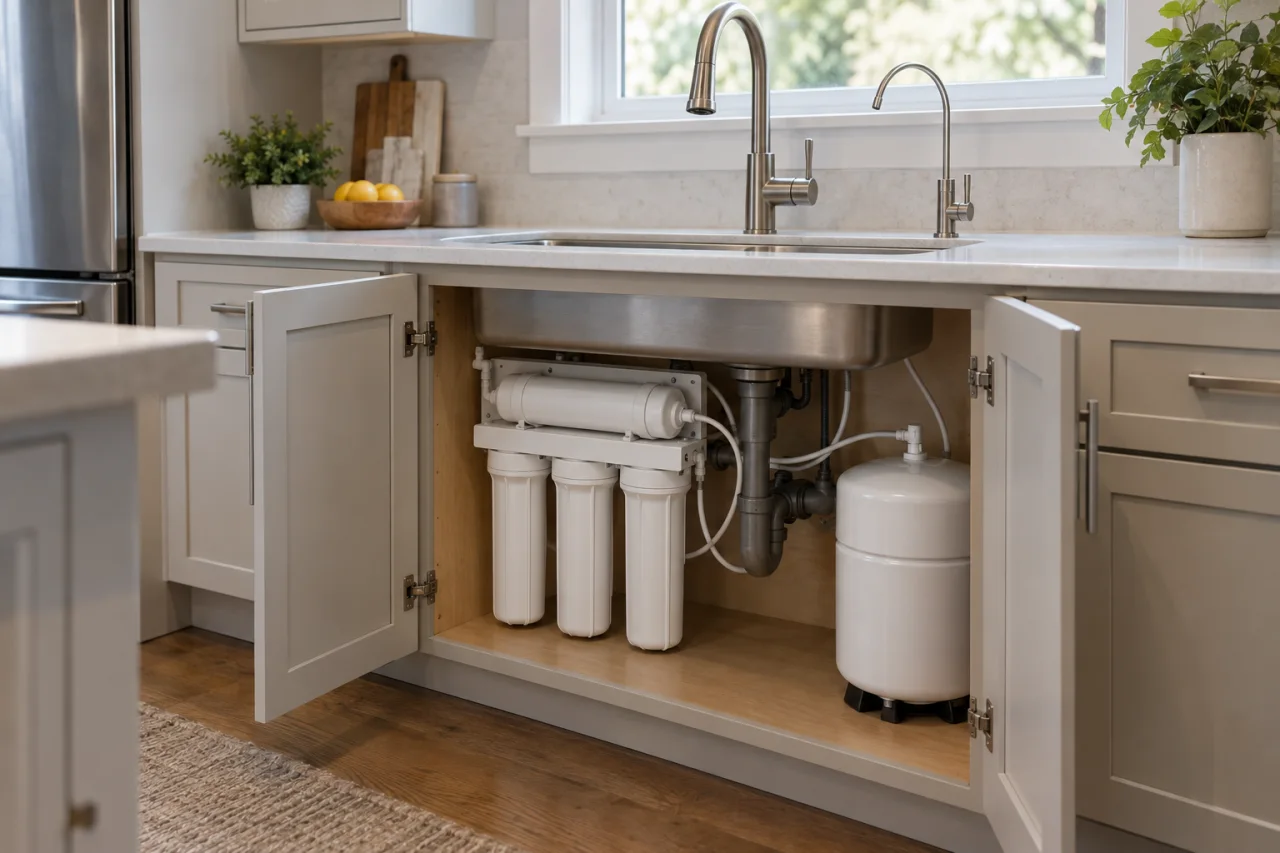
Before ordering cartridges, find the model number and its matching owner’s manual. Record the replacement part numbers and determine whether the system uses a storage tank or produces water without one. That distinction matters when investigating weak delivery or planning a restart.
The Water Knight installs Drinking Water Systems for Moore County homes, including the InterFlo® QuadPro SST. Its maintenance directions should not be substituted for another RO model’s instructions—or vice versa.
Keep a simple record of installation, cartridge changes, sanitation and unusual behavior. A useful entry says which component changed, not simply “filters done.” If you are reviewing the ongoing costs of a reverse osmosis drinking water system, separate routine cartridges from membrane replacement, sanitation and diagnostic work.
Know the difference between filters and the membrane
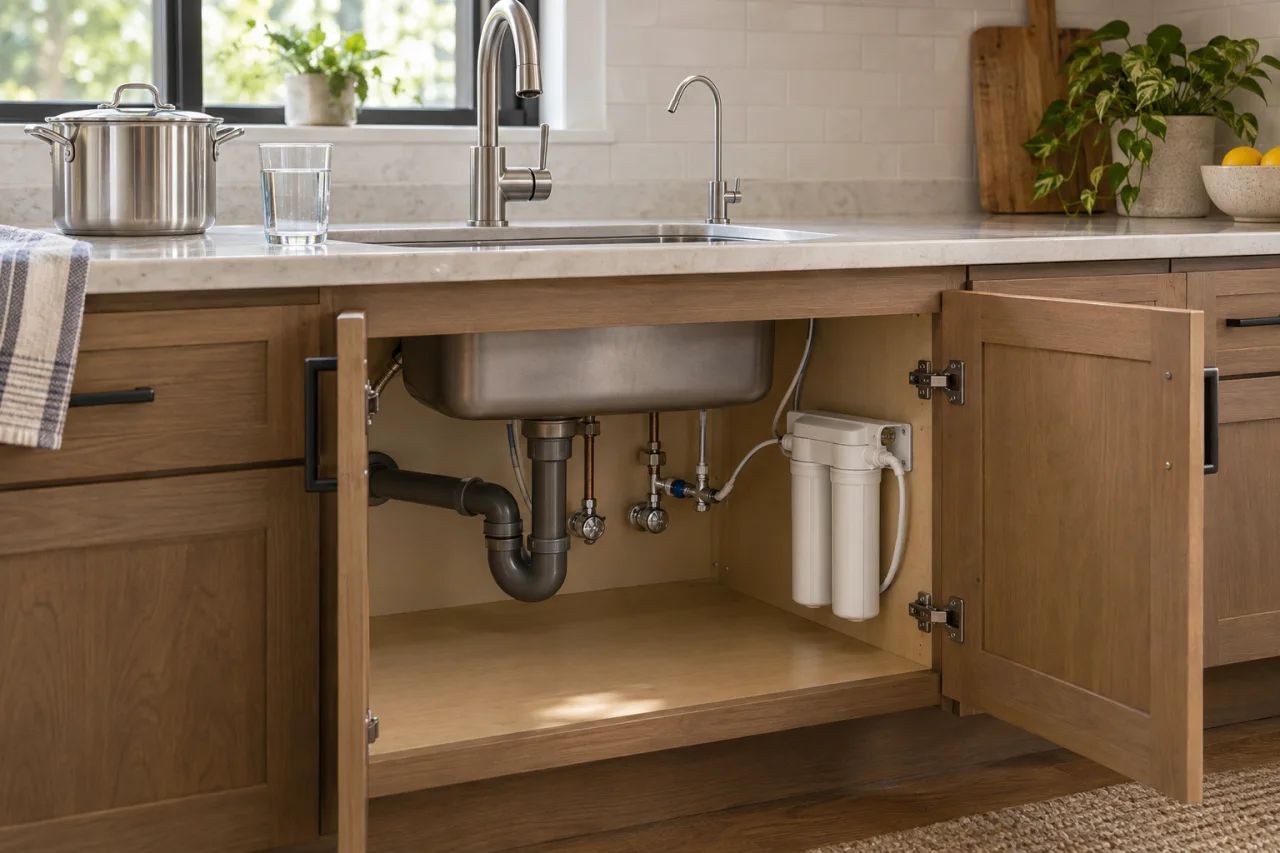
An RO system is more than its membrane. Water usually passes through treatment before and after that membrane, and each component serves a different purpose. Some products combine several treatment functions inside one cartridge, so stage count does not necessarily equal cartridge count.
Use this comparison to understand the jobs, not to select a replacement by appearance. The approved cartridge and its position must match the equipment instructions.
Typical RO component roles; actual media, arrangement and replacement requirements vary by model.
| Component | Typical purpose | Important limitation |
|---|---|---|
| Prefilter | Treats incoming water before the membrane; may reduce sediment and chlorine. | Replacing it does not replace the membrane or verify every reduction claim. |
| RO membrane | Separates treated water from a reject stream carrying concentrated dissolved substances. | Performance depends on operating conditions and the system’s specified applications. |
| Postfilter | Treats water after the membrane, commonly to improve remaining taste or odor. | Better taste is not proof that the water is microbiologically safe. |
Use the correct schedule—and understand the alert
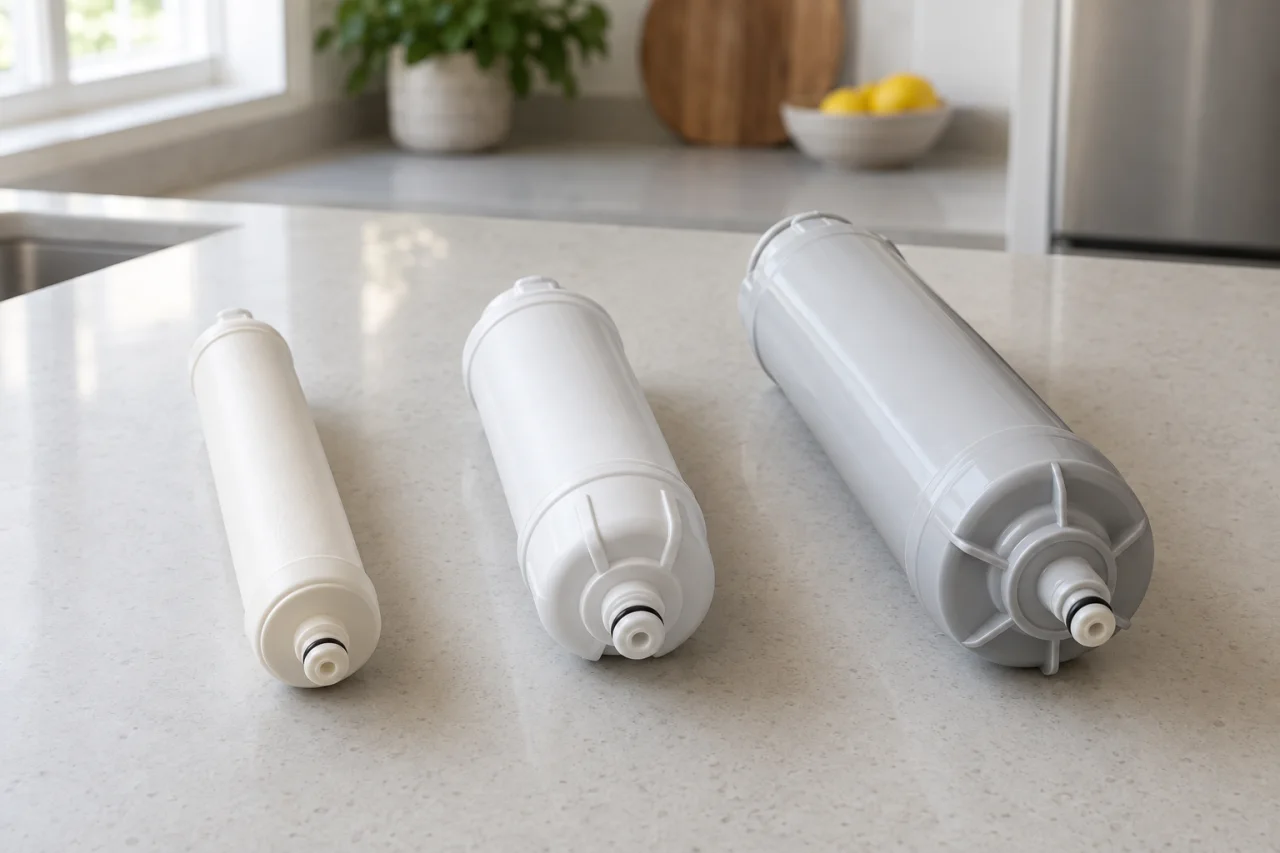
Replacement schedules are model-specific, not universal RO rules. The InterFlo® QuadPro SST manual gives a general normal-use schedule of 12 months for its pre-composite and post-composite filters and 48 months for its membrane. It also explains that input-water quality, pretreatment and water use can change replacement needs. These are maintenance guidelines, not guaranteed service lives.
For this model, white indicates normal cartridge status, orange means replacement is approaching and red means the cartridge has expired and requires replacement. Other systems may use different colors or codes.
An indicator is not a laboratory result. Identify what the alert means before clearing it, and use the prescribed reset procedure after the required work. Ask which cartridge triggered the alert and whether the proposed replacement includes the required flushing.
Investigate slow flow before buying parts
Slow flow is a symptom, not a diagnosis. Depending on the design, possible causes include restricted cartridges, low incoming pressure, colder feed water, tank problems or a pump or valve fault. Replacing the membrane first can mean buying the wrong part while leaving the actual restriction unresolved.
Begin with observations rather than dismantling equipment. If the system has a tank, report whether it delivers normally at first and then slows. A tankless unit needs a different troubleshooting path; advice about adjusting tank pressure does not apply.
Do not connect an RO system to hot water to increase production. If there is active leakage, stop using the system, isolate its water supply if safe and seek assistance. Keep water away from electrical connections.
- Compare the RO faucet with another cold-water tap: is the change isolated to the RO?
- Note whether delivery is weak immediately or only after substantial use.
- Check for visible tubing pinches, dampness or a recently moved object pressing against equipment.
- Record cartridge age, alerts and any recent interruption in water or electrical supply.
- Leave internal repairs and storage-tank pressure adjustments to the model-specific troubleshooting procedure.
Treat sanitation as its own maintenance requirement
Changing a cartridge and sanitizing a system are separate tasks. Sanitation requirements depend on the equipment, the maintenance event and the water conditions. For example, Moen’s F9930 guidance recommends sanitation when that RO membrane is replaced and specifies its own chemical introduction and tank-purging sequence. That is an example of model-specific guidance, not a recipe for other equipment.
Before beginning, confirm the approved sanitizer, concentration, contact time, components to remove and final flushing requirements. If the manual does not explain the situation, ask the manufacturer rather than improvising with household cleaners.
For routine filter handling, wear gloves and wash your hands afterward. People with weakened immune systems should avoid changing filters themselves because used media can expose them to captured germs or chemicals. Ask what work is appropriate for an owner and what requires professional help.
Plan for extended non-use before leaving
Before leaving a home unused for an extended period, look up the system’s shutdown and return-to-service directions. Do not assume that leaving it full, draining it or removing cartridges is suitable for every design.
The Watts RO-PURE manual, for example, includes a specific procedure for non-use longer than two months, with cartridge storage and restart directions. That threshold and procedure belong to that model; they are not a general rule for the InterFlo® QuadPro SST or other systems.
If equipment has already sat unused and its history is uncertain, describe that history before drinking from it again. Ask whether inspection, replacement, sanitation or flushing is required. A home affected by suspected source-water contamination needs a separate safety assessment, not just a routine vacation restart.
Use TDS as a clue, not a safety certificate
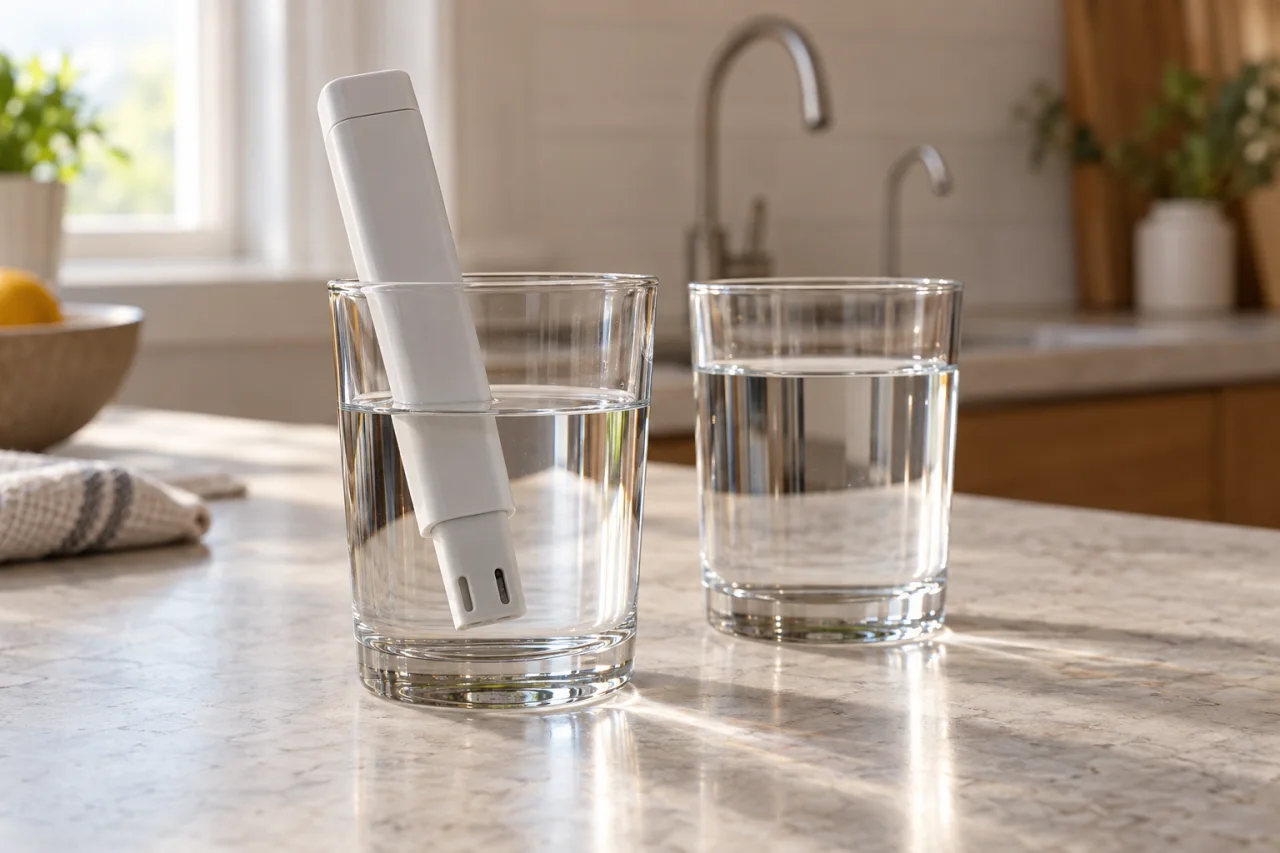
A handheld TDS meter generally estimates dissolved solids from electrical conductivity. Used as directed, it can help track RO performance. It cannot establish microbiological safety, identify every substance present or prove that all advertised reductions are being achieved.
NSF/ANSI 58 requires TDS-reduction testing, while many individual contaminant-reduction claims are optional. Therefore, a system’s certification to the standard does not mean every optional claim applies. Check the exact model’s listing and performance data for the substance you want reduced.
Treat a changing TDS result as a reason to investigate, not an automatic membrane diagnosis. Follow the manufacturer’s sampling and evaluation instructions. When the question concerns bacteria, lead, nitrate or another particular contaminant, Water Testing should address that question directly through appropriate testing rather than a general meter reading.
Make the next service conversation specific
A new taste or odor deserves attention, but neither pleasant taste nor clear appearance proves safety. Consider whether the change affects only RO water or other taps, whether maintenance is overdue and whether the source water has changed.
For well owners, RO maintenance does not replace source-water monitoring. The guide to private well testing in Moore County explains that separate responsibility. If contamination is suspected, do not treat a new cartridge as clearance to resume drinking; follow the relevant health authority’s advice and arrange appropriate testing.
The Water Knight serves West End and Moore County, with water treatment visits by arrangement. When requesting help, describe the observations and ask to review the proposed work before proceeding. A useful maintenance plan explains what needs attention now, what can be monitored and what remains uncertain.
- Which exact cartridges are due, and what evidence supports replacing the membrane?
- Does the proposed work include sanitation, flushing, indicator reset and a leak check?
- Is any recommended test a general performance check or a test for a specific contaminant?
- Could incoming water conditions require pretreatment or further investigation?
Questions & answers
Do all RO filters need replacing together?
Not necessarily. Prefilters, postfilters and membranes can have different replacement schedules. Follow the exact model’s instructions and confirm which components are due rather than assuming every cartridge needs replacement.
Does slow flow mean the membrane has failed?
No. Restricted filters, supply conditions and equipment faults can affect delivery. On systems with storage tanks, tank condition also matters. Note whether flow is always weak or declines after a large draw before requesting troubleshooting.
Can I trust the water if the TDS reading is low?
A low TDS reading does not establish microbiological safety or verify every contaminant-reduction claim. Use the system’s performance instructions for monitoring and contaminant-specific laboratory testing when needed.
Should I sanitize the system whenever I replace a filter?
Use the manufacturer’s sanitation schedule and procedure. Some instructions connect sanitation with membrane replacement; others specify a separate interval. Do not transfer chemical amounts, cartridge-removal steps or flushing directions from another model.
What information should I have ready when asking for help?
Gather the model, cartridge part numbers, last replacement dates, alert color or code, when the problem began and whether there was recent plumbing work or extended non-use. Mention any leak or source-water concern separately.
Sources & further reading
- Water-Right: InterFlo QuadPro SST Installation Guide and Owner’s Manual
Model-specific InterFlo QuadPro SST cartridge intervals, factors affecting replacement needs, indicator colors and tankless configuration. These instructions are not presented as universal RO requirements. ([water-right.com](https://www.water-right.com/wp-content/uploads/2024/09/QuadPro-SST-Manual.pdf))
- Pentair: PRF-RO Installation and Operation Manual
Typical prefilter, membrane and postfilter functions; cold-water operation; operating-condition limits; and the need to follow equipment-specific replacement instructions. ([pentair.com](https://www.pentair.com/content/dam/extranet/nam/filtration/pentair/manuals/4000413_prfro_manual.pdf))
- CDC: About Choosing Home Water Filters
Maintenance and filter-handling precautions, advice for people with weakened immune systems, limitations of taste and appearance, contaminant-specific filter selection and private-well testing. ([cdc.gov](https://www.cdc.gov/drinking-water/prevention/about-choosing-home-water-filters.html))
- NSF: NSF/ANSI 58—Reverse Osmosis Drinking Water Treatment Systems
NSF/ANSI 58 requires TDS-reduction performance testing and offers separate optional contaminant-reduction claims, supporting the distinction between TDS performance and specific certified reductions. ([nsf.org](https://www.nsf.org/knowledge-library/nsf-ansi-58-reverse-osmosis-drinking-water-treatment-systems))
- Moen: System Maintenance—Sanitizing Your System, F9930
The F9930-specific recommendation to sanitize during membrane replacement, including prescribed sanitizer introduction and subsequent tank purging; illustrates why sanitation instructions cannot be transferred between models. ([solutions.moen.com](https://solutions.moen.com/Article_Library/System_Maintenance%3A_Sanitizing_your_system-F9930))
- Watts Premier: RO-PURE Installation, Operation and Maintenance Manual
RO-PURE-specific extended-non-use and restart directions, sanitation requirements, and troubleshooting involving pressure, temperature, restricted filters and storage-tank conditions. ([dam.watts.com](https://dam.watts.com/AssetLink/642230.pdf))
- Berkey Water Systems: What a TDS Meter Can and Can’t Tell You
Handheld TDS meters generally estimate dissolved solids using conductivity; a TDS result alone cannot establish water safety or detect microbiological and other contaminant concerns. ([support.berkeywater.com](https://support.berkeywater.com/about-tds-meters/))
Prepared and automatically checked on . Conditions, costs and requirements can change. Ask about the details that apply to your situation.
Continue reading
Helpful next reads
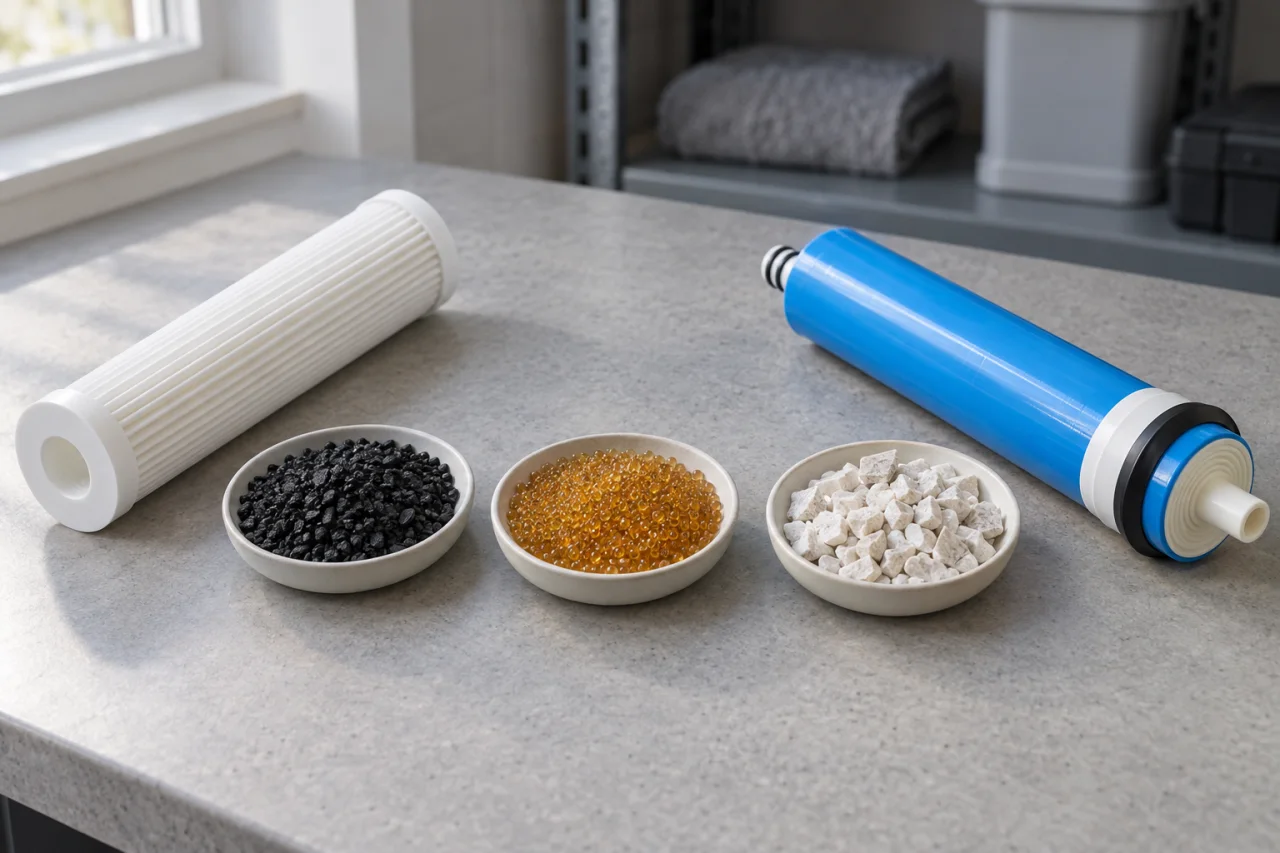
Carbon, Resin, Membranes and Mineral Media: A Water Treatment Options Guide
The material inside a treatment system determines its job. Compare carbon, resin, membranes and mineral media by water results, flow needs, upkeep and discharge.
Whole-House or Under-Sink Filtration: Where Should Treatment Happen?
Whole-house treatment is not automatically the better choice. Compare where water is used, what needs reducing and how much maintenance each option requires.

PFAS and Your Drinking Water: What to Check Before Choosing a Filter
PFAS concerns call for specific evidence, not a bigger filter by default. Find relevant results, understand their limits and verify the exact treatment claim before buying.