Practical guides · comparison
Sanitizer Plus®, a Water Softener or UV: Different Jobs, Similar-Sounding Claims
Sanitizer Plus® sanitizes its conditioning tank; that is not a drinking-water disinfection guarantee. Learn how softeners, conditioners and UV differ—and which test results should guide your choice.
What you’ll learn
- Sanitizing a conditioner’s media bed is not the same as disinfecting drinking water.
- Conventional softeners, Sanitizer Plus® and UV address different objectives and may be used together.
- Check the exact conditioner model, UV certification, inlet-water limits and rated flow before comparing proposals.
- Positive bacterial results require their own precautions, investigation and confirmation testing.
The word sanitizer can make a conditioning system sound interchangeable with UV disinfection. It is not. For homeowners comparing treatment options, the important distinction is between improving mineral-related water problems, controlling growth inside equipment and addressing microorganisms in drinking water. Here is how to separate those jobs and ask for equipment that fits the actual test results.
First, separate tank sanitation from drinking-water disinfection
No: a system that sanitizes its own media does not provide the same protection as drinking-water UV disinfection. Sanitizer Plus® uses chlorine-generating technology to prevent bacterial growth that can cause odors inside its tank. Its manufacturer explicitly states that the chlorine generator is not intended for treating non-potable water.
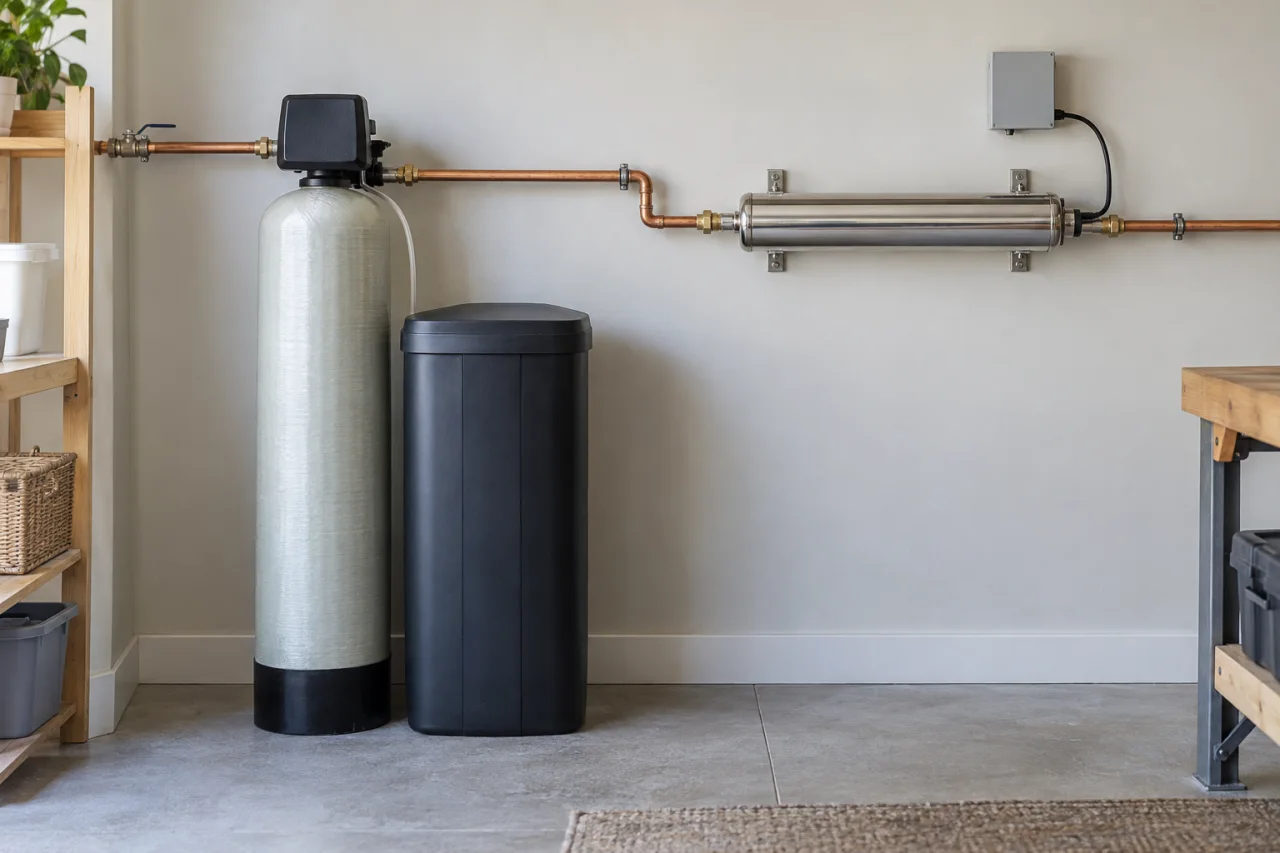
A conventional softener has another job: exchanging hardness minerals for sodium or potassium. UV uses light to inactivate microorganisms passing through its chamber, subject to water quality, flow and equipment limitations.
These distinctions matter when comparing The Water Knight’s Water Sanitizer, Water Softener and UV Water Systems services. The useful question is not which name sounds most protective, but which measured problem each proposed unit addresses.
Compare the job, not just the equipment
Start with the treatment objective. Hardness reduction, iron and manganese reduction, pH adjustment and microbial disinfection are separate goals, even when one unit performs several functions.
The options below are not necessarily alternatives. A home may need conditioning before UV, while another may need hardness treatment without an identified disinfection requirement. Compare equipment against the actual analysis rather than choosing the option with the longest feature list.
Three treatment approaches: where each fits and what it does not replace.
| Option | Primary application | Benefits | Tradeoffs and limitations | Ownership considerations |
|---|---|---|---|---|
| Conventional ion-exchange softener | Primarily calcium and magnesium hardness | Reduces hardness associated with scale and soap residue | Not drinking-water disinfection; do not assume iron, manganese or pH treatment without model-specific support | Salt replenishment, regeneration water and equipment servicing |
| Sanitizer Plus® conditioner | Hardness and suitable iron or manganese conditions; pH adjustment on applicable models | Combines conditioning functions with chlorine generation for sanitation inside the tank | Not a substitute for treating microbiologically unsafe water; model, media, inlet chemistry and flow determine suitability | Salt, regeneration water, generator components and model-specific servicing |
| UV disinfection system | Microorganisms within the selected system’s validated treatment application | Inactivates susceptible microorganisms without adding a disinfectant chemical | Does not soften water or correct mineral problems; requires suitable incoming water, controlled flow, power and maintenance | Electricity, replacement lamp, sleeve care and any required pretreatment |
Build two pictures of your water: chemistry and microbiology
Orange staining, dark deposits, scale and odors are reasons to investigate, not a diagnosis. For this comparison, useful chemistry measurements include hardness, iron, manganese, pH and total dissolved solids. UV planning also calls for turbidity and ultraviolet transmittance, or UVT: how much UV light passes through the water.
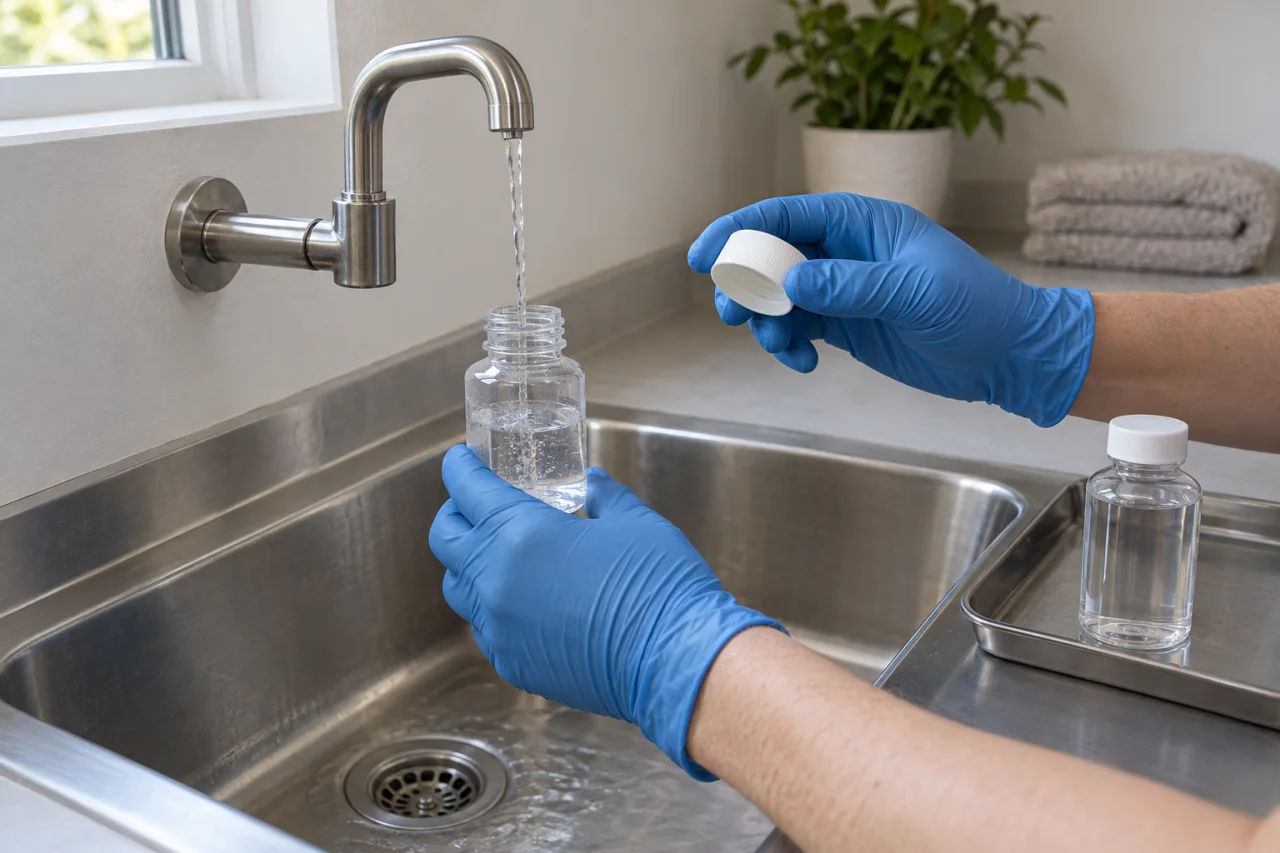
Keep bacterial testing separate from mineral testing. A hardness reading cannot establish whether coliform bacteria are present, and improved taste cannot confirm microbial safety. Use a state-certified laboratory for well-water testing and follow its sampling instructions.
For private wells, annual testing should include total coliforms, nitrates, pH and total dissolved solids. Ask about additional tests after flooding, well repairs or changes in water quality. Our guide to private well testing in Moore County explains that broader starting point; this equipment comparison does not replace it.
Read Sanitizer Plus® limits by exact model
Sanitizer Plus® is a product family, not one universal operating envelope. For example, the ASP1-1054 specifications list maximum hardness of 30 grains per gallon, maximum combined iron and manganese of 10 ppm, and minimum inlet pH of 6.0. Those figures are application limits, not a promise that every water supply at those limits will receive identical treatment.
The same manual lists a minimum inlet pH of 7.0 for ASP2 models and no pH-adjustment capacity for them. It also explains that combined iron and manganese removal depends on their form, pH and local conditions. Higher flow reduces pH-adjustment performance.
Ask which exact model and media are proposed, whether the inlet water meets all prerequisites, and what treated-water results are expected at normal demand. A headline claim about raising pH should never replace those details.
For UV, check certification, water quality and rated flow
UV certification also needs a close look. NSF/ANSI 55 distinguishes Class A systems for contaminated-water microbial treatment from Class B systems for supplemental treatment of already disinfected drinking water. Not every residential UV unit has the same certification or intended application.
For a concrete example, the VIQUA D4/E4/F4 family manual lists recommended incoming iron below 0.3 mg/L, manganese below 0.05 mg/L, hardness below 7 grains per gallon and turbidity below 1 NTU. It specifies UVT above 75% for standard models, with different provisions for designated 50+ models. These are examples from that manual, not universal limits for all UV equipment.
Flow matters too: faster passage reduces exposure time. Ask for the rated flow at the required dose and applicable UVT, not simply the largest gallons-per-minute number in a brochure. Confirm the exact model’s certification separately.
Let bacterial results change the plan
A positive coliform result deserves a separate response even if staining and odors have improved. Total coliforms are indicators of possible contamination; an E. coli finding suggests fecal contamination. Neither should be dismissed because a conditioner has a sanitizing feature.
Contact the local health or environmental department to interpret the report and establish appropriate precautions, investigation and follow-up sampling. If harmful contamination is suspected or confirmed, use bottled water or another safe source while obtaining guidance. Boiling does not remove chemical contaminants.
Treatment may be part of the response, but installing a unit is not the same as confirming the problem has been resolved. Follow guidance on treating the contamination and testing afterward before resuming use. The source of contamination also needs attention, rather than assuming equipment alone answers every concern.
Plan the treatment combination and its upkeep
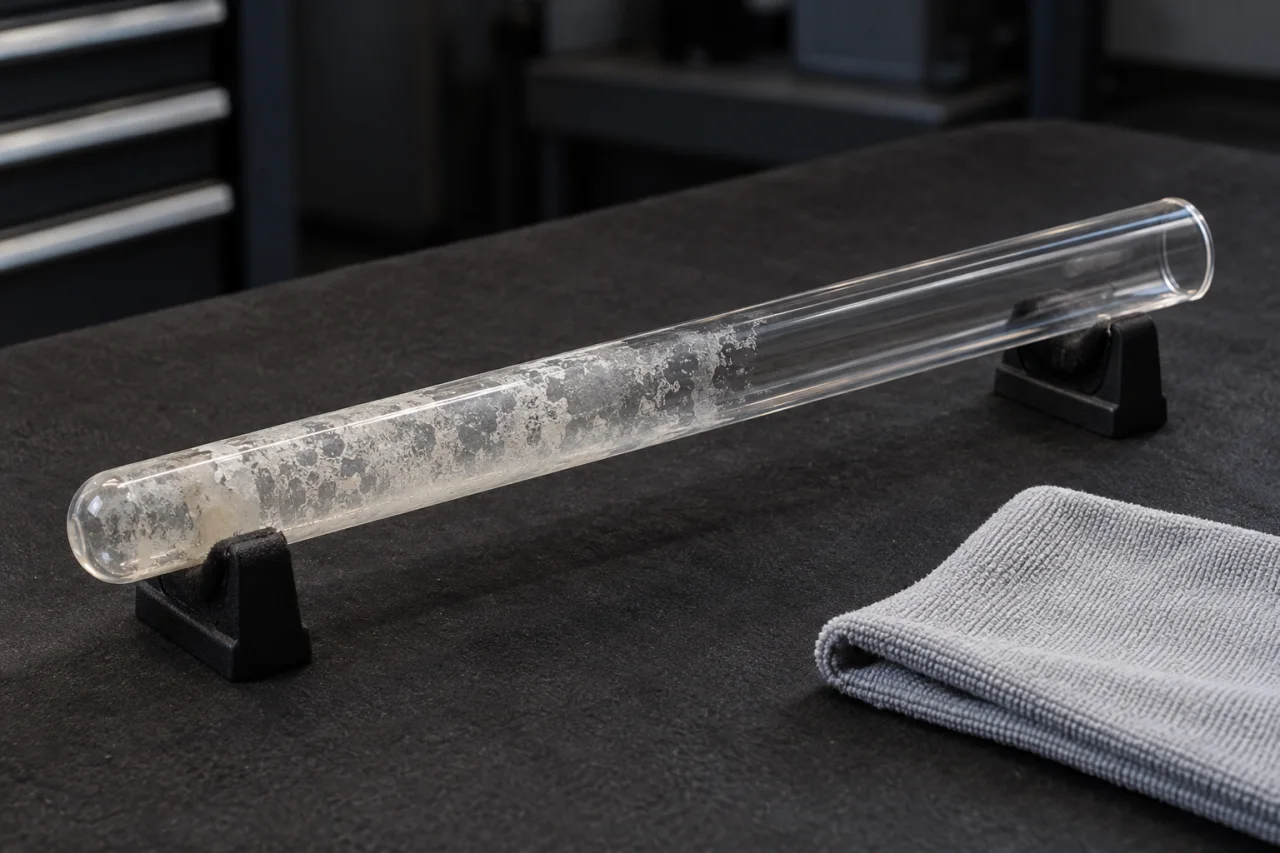
Conditioning and UV can complement each other. Hardness, iron and manganese can deposit on the quartz sleeve, while suspended particles can shield microorganisms from UV light. Pretreatment must address the actual conditions entering the chamber; clear-looking water alone is not enough.
Ownership responsibilities differ. A regenerating conditioner needs salt and appropriate regeneration settings. UV needs electricity, lamp replacement on the model’s schedule, sleeve care and maintained pretreatment. Lamp schedules vary, so do not transfer one product family’s interval to another.
A lamp-status indicator is not equivalent to a sensor measuring UV intensity. Ask what the proposed unit monitors, which conditions trigger alarms and whether water flow stops automatically during a fault or power loss. Review UV system alarms and maintenance before deciding which safeguards you want.
Ask for a proposal that connects each unit to a result
Compare written proposals for the same objectives, not simply the number of tanks. Meaningful cost factors include treatment capacity, plumbing access, drainage, electrical requirements, necessary pretreatment and monitoring or shutoff features. Ask which installation work, consumables and follow-up services are included, and which are separate.
A lower equipment price may leave out a treatment stage needed to meet the next unit’s operating limits. Conversely, buying additional equipment without a defined objective does not establish better water quality.
For a home or business in West End or Moore County, The Water Knight offers water testing and treatment services, with visits by arrangement. Bring existing laboratory reports and a description of the problem so the discussion can focus on treatment goals, suitable options and ongoing care.
- Which laboratory results justify each proposed treatment stage?
- What exact model, media and certification are included?
- Will treated water meet the UV inlet requirements at expected demand?
- What salt, water, electricity, lamps, cartridges and service will ownership require?
- What happens during regeneration, bypass operation, an alarm or a power interruption?
- What follow-up testing is appropriate, and is it included?
Questions & answers
Does Sanitizer Plus® replace UV disinfection?
No. Its chlorine-generating feature controls bacterial growth inside the conditioning tank. The manufacturer states that the generator is not intended to treat non-potable water. A drinking-water microbial concern needs a separate assessment and an appropriately selected disinfection response.
Can a water softener and UV system work together?
Yes. Where hardness exceeds the UV model’s recommended limits, softening can help limit mineral deposits on the quartz sleeve. UV then addresses the microbial treatment objective. Neither function replaces the other.
Does every Sanitizer Plus® model raise low pH?
Do not assume so. The ASP1/ASP2 manual lists different minimum inlet pH values and identifies pH-adjustment capacity for ASP1 models, not ASP2 models. Confirm the exact model, media and expected performance at your household’s flow.
Is every residential UV system certified for contaminated water?
No. NSF/ANSI 55 Class A and Class B have different applications. Class B provides supplemental treatment of already disinfected drinking water. Check the exact model’s certification and operating limits rather than relying on the brand name or the word validated.
Should I stop testing my well after installing treatment?
No. Continue at least annual well testing for total coliforms, nitrates, pH and total dissolved solids, with additional testing based on local concerns or changing conditions. After contamination treatment, follow professional guidance on confirmation sampling before resuming use.
Sources & further reading
- NSF: Standards for Water Treatment Systems
Supports the distinction between softener ion exchange and UV treatment, including NSF/ANSI 55 Class A versus Class B applications. Used in the comparison table, certification section and FAQs. ([nsf.org](https://www.nsf.org/consumer-resources/articles/standards-water-treatment-systems))
- Water-Right: Sanitizer Plus Series® Systems Brochure
Supports Sanitizer Plus® conditioning functions, chlorine generation to prevent odor-causing bacterial growth inside the tank, and the explicit limitation that the generator is not intended for treating non-potable water. ([water-right.com](https://www.water-right.com/products/sanitizer-plus/lit-san-2/))
- Water-Right: Sanitizer Plus Series® ASP1/ASP2 Installation Instructions and Owner’s Manual
Supports ASP1-1054 hardness, combined iron/manganese and minimum inlet-pH specifications; ASP2 pH limitations; flow-dependent pH adjustment; regeneration requirements; and the warning that conditioners do not remove coliform bacteria. ([water-right.com](https://www.water-right.com/wp-content/uploads/2022/07/Water-Right-Sanitizer-Plus-Manual_web.pdf))
- VIQUA: D4 Premium, E4, F4 and Related Models Owner’s Manual
Supports the D4/E4/F4 family’s recommended inlet iron, manganese, hardness, turbidity and model-dependent UVT conditions, plus dose-dependent flow ratings and model-specific certification distinctions. ([viqua.com](https://viqua.com/wp-content/uploads/MNL520351-R_RevE-EN.pdf))
- VIQUA: Frequently Asked Questions
Supports lamp replacement and sleeve-cleaning obligations, maintenance of pretreatment, differences between lamp-out monitoring and UV sensing, flow restrictions, and the fact that UV does not change taste or odor. ([viqua.com](https://viqua.com/resources-24/faqs/))
- VIQUA: UV Pretreatment
Supports how turbidity and suspended material interfere with UV treatment and how iron, manganese and hardness deposits can foul the quartz sleeve. ([viqua.com](https://viqua.com/uv/pretreatment/))
- VIQUA: How Does UV Treatment Work?
Supports the relationship between UV intensity, exposure time, flow, UV transmittance and effective treatment. ([viqua.com](https://viqua.com/uv/how-uv-works/))
- CDC: Guidelines for Testing Well Water
Supports annual private-well testing, state-certified laboratory use, additional testing after changing conditions, and the interpretation of total coliform and E. coli as contamination indicators. ([cdc.gov](https://www.cdc.gov/drinking-water/safety/guidelines-for-testing-well-water.html?utm_source=openai))
Prepared and automatically checked on . Conditions, costs and requirements can change. Ask about the details that apply to your situation.
Continue reading
Helpful next reads
What Should You Do With Well Water After Flooding or a Power Outage?
A working pump does not establish water safety. Separate power loss from flood exposure, choose temporary water carefully, and use appropriate assessment and testing before resuming use.
Carbon, Resin, Membranes and Mineral Media: A Water Treatment Options Guide
The material inside a treatment system determines its job. Compare carbon, resin, membranes and mineral media by water results, flow needs, upkeep and discharge.
Water Softening vs. Salt-Free Scale Control: What Actually Changes?
A salt-free scale-control device is not simply a softener without the salt. Learn which results each approach can deliver—and what to check before choosing.